
Should I buy a Jimny?
Consider this one a bit of a FAQ from people considering a Jimny. It’s more targeted at people buying a current generation of Jimny, especially those considering one new, and to help people understand the good and the bad of them.
Sections
- The Jimny
- What the Jimny is
- What the Jimny isn’t
- Areas of compromise
- Size
- Power
- Space
- Features
- Safety
- Value
- Historic context
- Is it good value?
- How even do we think about value?
- Parting thoughts on should you buy one?
The Jimny
The Jimny is, fundamentally, a niche vehicle for a particular buyer. At no point in the car’s history has it been designed for mass-market appeal; it is designed to be what it is and that’s it.
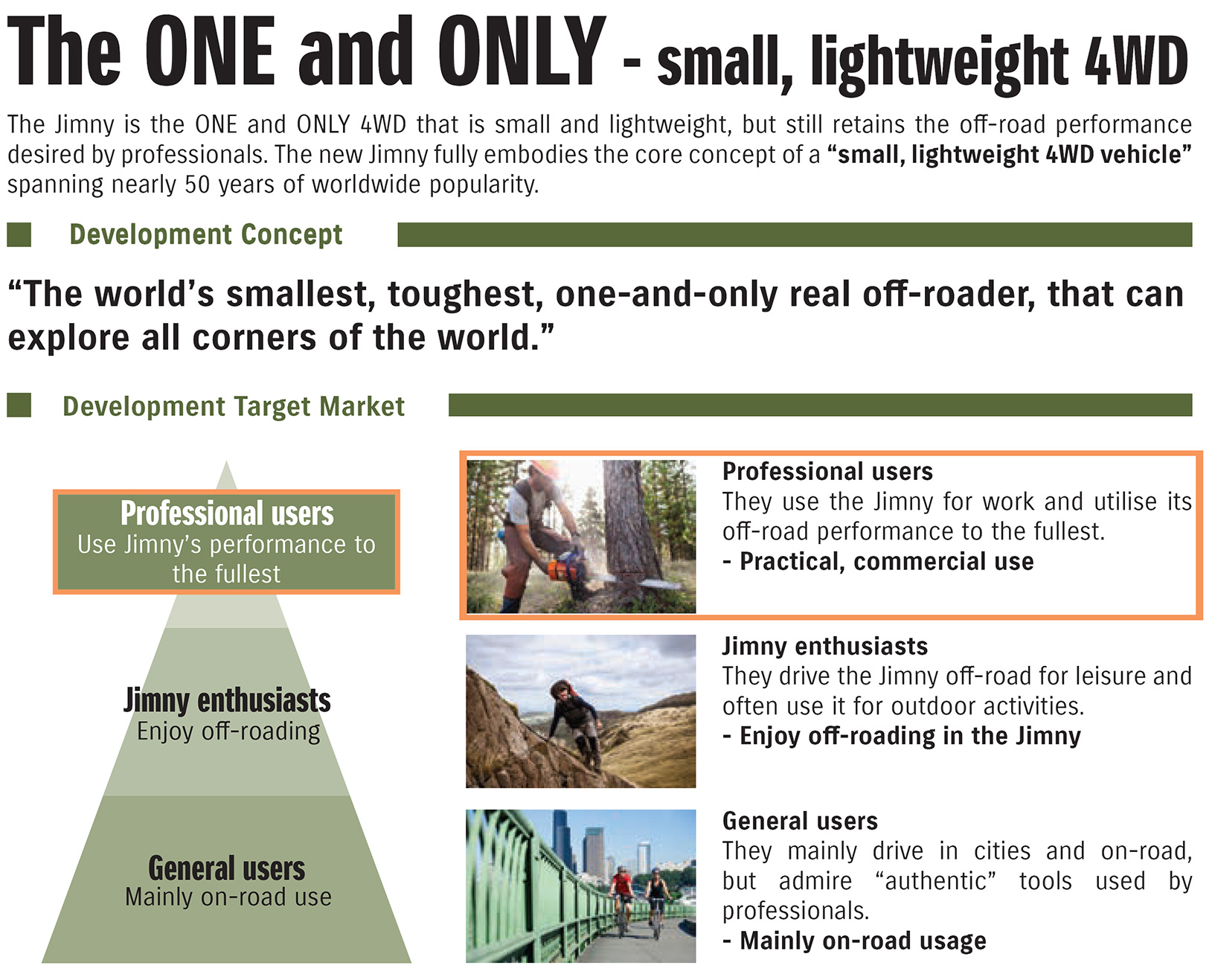
Anyone wanting to buy one needs to start from that aspect. While you can modify them to either refine some facet or reduce the compromises that the car might represent, it will always be a niche vehicle.
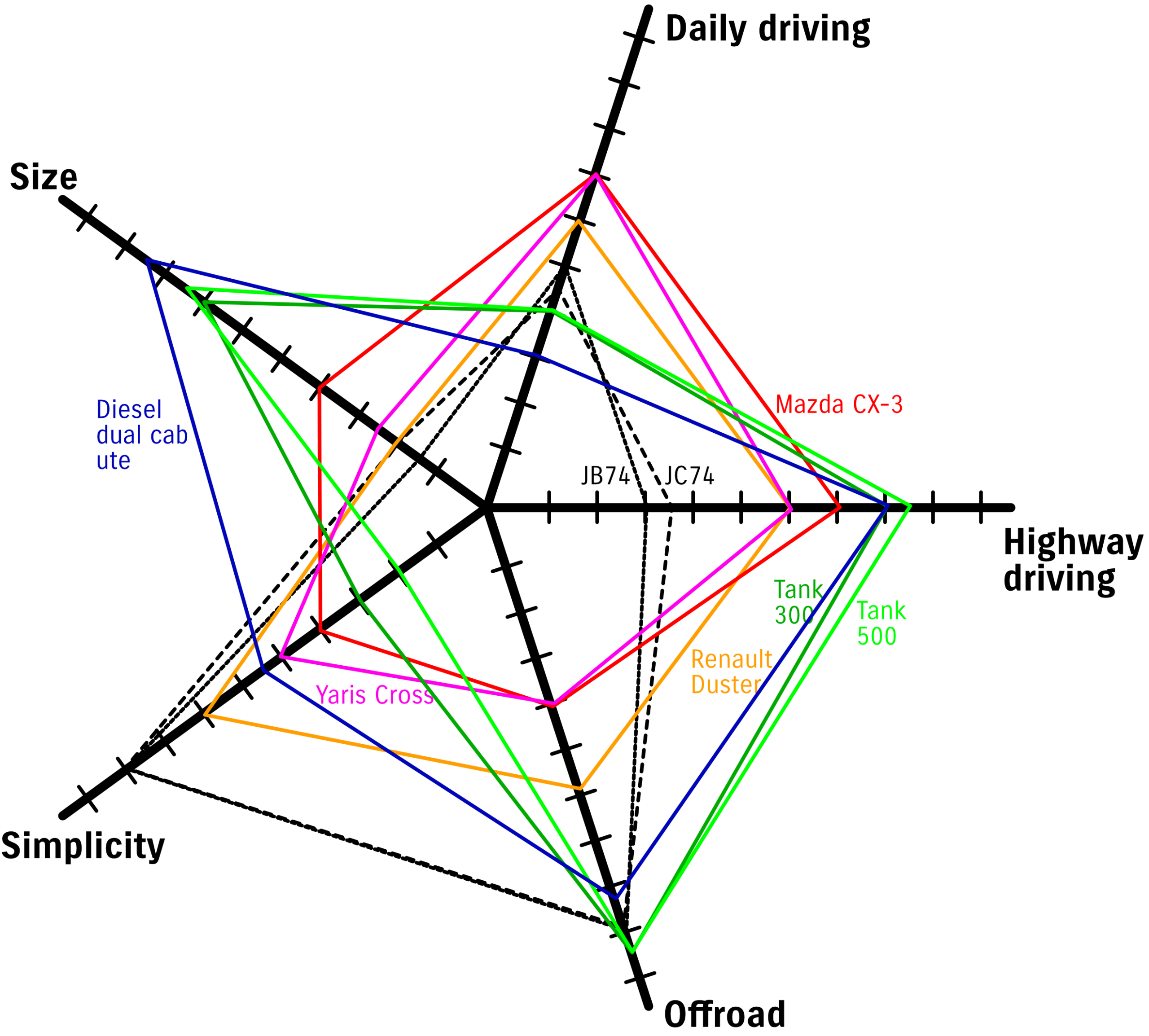
People might be interested in the Jimny purely for how they look. I get that; it’s an appealing car with the right amount of retro throwback with just enough stuff to allow it to be sold in the present time. However, unless that is your only buying spectrum you might find yourself disappointed with the car. It’s worth breaking down what the Jimny is and isn’t before you go any further.
What the Jimny is
First and foremost, the Jimny is small. Most cars have been gradually getting bigger over the years, especially ones sold for the 55 years and counting that small Suzuki 4wds like the Jimny and its ancestors are. Take some typical small cars like a Volkswagen Golf (1974-today) or a Toyota Corolla (1966-today, front wheel drive hatchbacks 1983-today): an original Golf was 3.7m long and today is 4.3m long; a 1983 Corolla hatchback 3.9m long and today 4.4m.
In contrast to this inevitable increase, an LJ10 started life at 3m long and a JB74 in 2026 is 3.6m. They have been ~3.5m long for a 3 door since 1980; they always have been small. Even a 5 door JC74 is just under 4m in length, and both the 3 and 5 door cars are narrow. The width is quite a lot of of what gives a car the perception of size; the Jimny rarely has gained no width over more than 50 years of history.
This all harks back to what actually pays for the Jimny’s development: in Japan, they have a class of cars termed the ‘kei cars’. A kei car has a limit on size and weight in return for discounts on registration and parking requirements. It is this underpinning which has kept the Jimny small.
Suzuki have branched out into larger 4wds before. An original Vitara was conceived as a more road focussed but still highly offroad capable 4wd. In the late 1980s these started out roughly Jimny sized (3 door ~3.7m long, 5 door 4m long), but today have morphed into a much larger and very much more road focussed softroader, mimicing the creep of most of the world’s vehicle fleet. It is for this size alone the Jimny can be regarded as an anomaly in car development and you have to assess it through those eyes.
Jimys are also unapologetically biased towards offroad capability and longevity even in tough conditions. This doesn’t mean I’m saying they’re abuse proof and nothing will break (they are a small car); however, the generation 4 Jimnys are explicitly designed to run on relatively low octane fuel for emerging markets, use relatively simple technology and maintain the types of suspension and axle setup that promotes offroad capability at the expense of on-road ride quality and comfort. That isn’t to say they’re horrific on road, but, their design is such that compromises are made onroad in favour of offroad aspects.
This bias towards an ability to live in sub-optimal areas and basis on a very small and non-powerful Japanese domestic market exclusive kei car means that the Jimny does not have a focus on power. Depending on who you ask it is somewhere between underpowered and adequately powerful; if more power was put into the platform then stronger axles or driveline or other considerations need to be made. It also would be less likely to meet the design requirement on working on poorer quality fuel in developing nations.
What the Jimny isn’t
While it’s a very usable car, the Jimny is not designed to be a highway km muncher. Don’t get me wrong; I’ve done plenty of long days in my car and it’s absolutely doable. If you anticipate that you can live with its abilities to do distance and deal with its foibles like a small tank and relatively poor highway speed fuel economy.
A Jimny is never going to be a powerhouse. The Jimny has always had a small, low power, relatively simple powertrain and there’s not really signs it’ll change anytime soon. This means driving at higher speeds, especially fully laiden, is going to require a bit more of a committed driving style.
The Jimny also is never going to be stable. It isn’t as dangerously unstable as people make out (also something I’ll touch on), but we are talking about a short wheel base car (even a 5 door is relatively short) running solid axles front and rear. People blame it on the boxy shape of the car, but the reality is it’s more down to the kind of steering it uses: there has to be a little play in a steering box, and, they run relatively little caster even standard which makes them nimble but always less biased to stability on the open road.
Areas of compromise
As stated in the introduction, the Jimny is a niche car which requires some compromises. Only you can assess if you can live with these compromises, and it’s important to be very honest with yourself about that. Long after the lustre of a new (or new to you) car has worn off you have to also be able to rationally live with the car. Rationalising those compromises is the key to knowing if you can do this or not.
Size
With the Jimny being small, this is the biggest compromise people need to accept. I’m not touching on your ability to store things, but more the understanding you need to have about its dimunitive stature and mass.
Cars have got larger and larger in part due to safety reasons, though the Jimny is safer than you might think given its size. We’ll touch in that in a bit.
Power
Back when a Jimny launched in the 1970s it was nimble and not that much slower than the majority of vehicles around it. However, developments especially in the 1980s and into the 1990s has reset people’s expectations. Nowadays a very boring hatchback can be a relatively spritely thing, let alone the excess of power that a lot of modern cars have (yet manage to be more reliable and use less fuel than the cars of yesteryear). This means people’s expectations are different, and the Jimny is a compromise in this regard.
Historically, it is the most powerful and quickest Jimny out of any of the generations, but with ~50 kW/tonne at factory GVM it certainly is never going to be hugely fast.
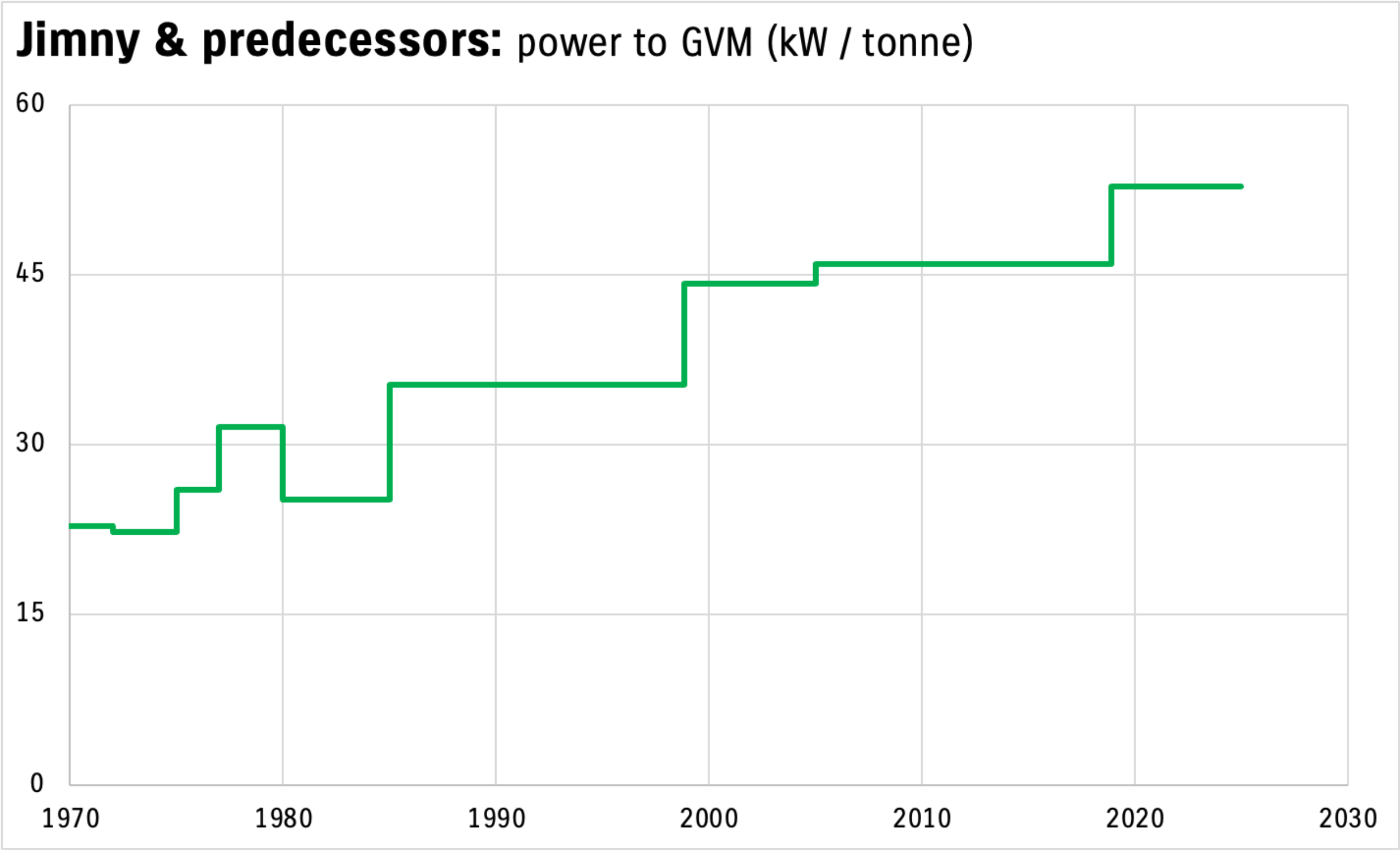
Personally, I don’t think they’re nearly as slow as people think. People are accustomed to instaneous low-rpm acceeration, but the Jimny with a small engine is going to require the use of more of the throttle pedal and more of the tachometer to make progress. Suzuki make engines that love revs, so don’t be shy about pedalling the car along and you’ll more than keep up with traffic.
Overtaking is (potentially) an exercise in planning on the open road, and you’re well outside the engine’s optimum efficiency band on the highways, but it is all doable. (And no, before you ask, dropping the rpm on the highway with longer gearing will not get you better economy, either. It is one of the compromises of the simplicity of the car and the drivetrain).
Handling and on-road ride quality
One of the design criteria being around offroad cability and strength and that means that Jimnys have persisted with a live axle suspension arrangement. Live axles are excellent offroad but they will always be compromised on road: they add unsprung weight reducing handling and on-road ride quality.
Shorter wheel bases will be more ‘flighty’ in their handling by the nature of their geometry, and being rear-wheel drive when driving on road and with limited weight in the rear then the car will tend to oversteer. This is also accentuated by suspension tuning which is designed for offroad, meaning the shock absorbers like to go down and stay down: this makes the back skip around over repeated bumps, reducing the handling.
Again, I think this is oversold as a problem as people as the handling is somewhat a perception of ‘feel’ and it feels different. Nevertheless, something narrow, short, and tall will always have some handling compromises.
Space
I’ve separated this out from the size angle as one of the compromises people need to understand is that the size is usable, but, you might need to put a lot more thought rather than just throwing something in. While you can get efficient in how you pack the car and make some choices with modifications to optimise your storage, it’s still small.
This smallness can be a benefit: if it’s only two of you, the simplicity of the 3 door boot arrangement actually has more room than a stock 5 door with its rear seats folded flat. You then have a roughly 1 m3 luggage space shaped like a cube in the 3 door, in something barely 3.6m long. You can park it anywhere in the city and yet fit a good amount of stuff in the back.
I just want to highlight that a little bit more when it comes to a (standard) 5 door: the rear seats do not fold flat in the 5 door, and they do in a 3 door. This means that the extra space doesn’t necessarily translate to better two-up luggage space without further modifications when we’re talking a 5 door.
You can also think of it this way:
- A 3 door Jimny is a choice between rear seat passengers or luggage
- A 5 door Jimny can have a very tiny amount of lugage and rear seat passengers
- Neither is ideal with lots of luggage and lots of passengers
I think people jump too quickly to worry about storage. You really need to use the car to understand the storage limitations and then find solutions to them, rather than just throwing a set of 4wd drawers at the back or something.
You can fit a lot in the back, e.g. I’ve done a reasonably large IKEA run with my 3 door, but it does require some thought.
If you want a car you can load up with every modern camping convenience, I don’t think the Jimny is for you. You can make it work with a couple of well-selected swags but it’s much, much better for the lightweight camper using a tent or similar. Even ignoring the space aspect, if you upgrade the GVM and have a 600-750 kg payload in the Jimny then using all of that payload will make the Jimny awfully slow and also reduces its strength about light weight and nimbeless offroad.
People can absolutely go overlanding in a Jimny, but you have to select things wisely to do so. I don’t think it’s an ideal car to put 400 Ah of lithium, a big inverter, and a full camp kitchen using induction etc. It can be done, and even with portable battery boxes stuff like coffee machines and air fryers are a bit more accessible, but I think there’s better cars if you want to load things up with features.
Space wise also extends a bit to the consideration about roof top tents. They’re very appealing to a lot of people from a safety/security/simplicity perspective. The downside is even the lightest roof top tent and a way to attach it to the car will exceed the Jimny’s roof load limit. This load limit is in line with larger vehicles once you account for the size and diminutive weight of the Jimny, but in absolute terms it is low at 30 kg. People do run roof top tents, but it is worth understanding all about the roof load limit before you decide to roll that dice especially around insurance.
The vast majority of people I know who have elected to run a roof top tent on a Jimny eventually end up selling it for ‘something bigger’ or ‘going in a new direction’. Same goes for people who go all in on all of the creature comforts in an overlanding build: overloading the car, be it with stuff, weight, or things on the roof is a recipe to wanting a different car because you’re trying to make the Jimny something it never will be.
Features
If you’re someone after a bunch of fancy car features then the Jimny probably will represent a compromise to you. While they come with power windows and a couple of semi-usable cupholders (unlike a base specification 79 series LandCruiser), they come with about the minimum they can get away with. You won’t find massage seats or luxury features like that, or a sophisticated infotainment system. The car doesn’t have keyless entry or push-button start, let alone connectivity and advanced vehicle telemetry back to a service.
For many people, the lack of features is actually a feature itself; however, it is a consideration if you’re after a luxury experience.
Safety
Related to features is the safety factor. Active collision avoidance features are the absolute minimum to allow the car to be sold in a modern world: Australian cars get 6 airbags, they have autonomous braking and they’ll alert you that you’ve strayed out of your lane. Along with ABS and traction control/stability control (ESP) that’s about it. Some of the safety features, e.g. lane departure warning, can be turned off and will stay off even after a restart. Many of these intervention devices are also disabled in low range, which is a positive thing for offroad use.
This does mean that people think you compromise on safety – and that also doubly comes with the car being small. Physical safety, as in the car’s ability to protect the occupants in a collision, was one of the focus areas for Suzuki in the development of the 4th generation Jimny. The chassis was significantly reinforced, cross-members changed or added to reinforce the car, and the side impact strength was sufficient to pass the increased side impact tests in Australia in 2021 without modification when many cars required modification to pass.
Physics will always be against a smaller car but there has been enough development in terms of the Jimny’s crumple zones & how it works that I’m ok driving it around. If you want a 5 star rated car with the latest active safety technology and is a giant insulated box then, unfortunately, the Jimny is never going to be that.
The Jimny is probably better at protecting front seat over rear seat passengers (the 5 door remains untested so we can’t say definitively for both 3 and 5 doors); again, this speaks more to the car being a 2 seat primarily over a 4 seater.
Fuel economy/range
This is the other thing you need to compromise on: the Jimny is not the most fuel efficient small car in its class due to is focus on being good offroad and a boxy shape, and, it has a small fuel tank (40 L standard). The fuel tank aspect is exacerbated by the fuel light coming on with between 8 and 10 L remaining, which for a 40 L tank means it’s roughly 1/4 tank.
The fuel economy is something that is made worse with modifications. Bigger tyres, a roof rack, awning hanging off the side, bunch of additional accessories like a bullbar all make it worse. In addition, once you modify the car and use it in tougher situations then you’ll also get worse economy. An automatic 5 door fully loaded with all of the accessories like a bullbar and full roof platform will get diesel dual cab ute or worse economy on the highway pushing it along at 110 km/h. On the flipside, a manual that’s standard ticking around suburban mixed streets will get you high 6L/100 km.
The fuel light is an aspect that a lot of people get worried about as it implies a relatively short range (e.g. it’ll come on a bit over 330 km gone since a refill for a standard car driven how most people drive them). Suzuki have made it so the fuel light gives a similar range to most cars of ~100 km of real-world driving, it just happens to be that’s a reasonable chunk of the total range. Either you get good at ignoring it and drive on, or, you stop more often.
The range also can be addressed through installation of a long-range tank, e.g. an 80 L full replacement tank is available. It doesn’t add that much weight so it doesn’t hugely affect the economy if you only half fill it, but if you totally fill it you practically get double the range. The fuel gauge still works correctly, and the fuel light is set up with the replacement float arm to still give 10 L remaining when it comes on.
Great things about the Jimny
There’s a huge amount of things to love about the Jimny (and I know I love mine just as much now, 7 years after buying it). As much as this article has focussed on the compromises for people to understand why a Jimny might not be for them, it’s also important to think about the reasons that maybe it’s the only choice for you.
More than capable stock
One of the perceptions of the Jimny is you have to modify it. You don’t; they are incredibly capable stock. There are optimisations you can do to make it better at something you want it to be better at, but, fundamentally it needs nothing.
One aspect here to understand is, if it’s your first 4wd, advice you get from larger 4wds about how to drive it might not always be valid. You need to use its small size to its advantage and take routes other people can’t take. The problem is, without experience, it’s hard to know what to ignore from experienced 4wders. If you want to get to understand the capabilities of your car, a 4wd course is more useful than any modifications when you’re beginning and also joining other Suzuki drivers to have a better idea of what works for a Jimny.
It’s a blank canvas
The flipside to the stock capabilities is there’s an endless array of modifications to make the car better for some aspect you want. None of these are essential, but some can be highly recommended.
- Tyres make a big difference to the types of terrain you might tackle.
The stock ones are better than people think, especially for sand, but being passenger constructed highway terrain tread pattern tyres they have their limitations. Just bear in mind changing tyres can have a fuel economy penalty. - If you’re worried about range then a long distance tank is well worth the money: storing jerrycans around the car can be tricky and might do things like exceed the roof load limit, but also annoying to stop and refill. Being about to do 800+ km even with a modified Jimny before needing to refuel unlocks a lot more possibilities.
- The suspension can benefit from an upgrade.
Common wisdom for most 4wds is that a suspension lift will make a car worse on-road: this isn’t necessarily true with the Jimny. Some of the suspension lifts have spring rates comparable to or slightly softer than standard, and with better shock absorbers & making sure you correct the caster the car really has no drawbacks. Or, if you really want to bias to onroad performance, shock absorbers and slightly stiffer springs can make a world of difference to the handling. It’ll never be hot hatch levels, but it’s more usable. - Almost every possible storage modification is available.
Especially true for the 3 door as it’s been out for longer and has a greater market penetration: there’s a heap of ways you can make the storage better. Along with packing carefully and/or maybe rethinking your camping arrangements, you can make the car highly optimised with everything tucked away in its own place, leaving you a free luggage space to nicely hold everything.
The problem, of course, is scope creep. You can easily overspend or over-accessorise, plus, when you’re starting out it’s easy to think everything is needed when changes to how you use or pack the car, or what you take would be a better choice.
Size
In terms of vehicles, especially when we’re talking a 3 door, there are few vehicles this small still available to buy. If you find value in adequate size rather than excess, then the Jimny presents a pretty compelling option for which there are few things like it. If you take the VFACTS Light SUV class that the Jimny fits in, the following competitors (in brackets, length x height) come up:
- Mazda CX-3 (4.3 m x 1.8 m)
- Toyota Yaris Cross (4.2 m x 1.8 m)
- Hyundai Venue (4.0 m x 1.8 m)
- Kia Stonic (4.2 m x 1.8 m)
- Suzuki Fronx (4.0 m x 1.8 m)
- Renault Duster (4.4 x 1.8 m)
- Hyundai Inster (3.8 m x 1.6 m)
- Nissan Juke (4.2 m x 1.8 m)
- Jeep Avenger (4.0 m x 1.8 m)
Contrast this to the Jimny: in 3 door form it is 3.6 x 1.6 m wide, and even a 5 door is 3.9 m x 1.6 m.
Once you get into larger 4wds, that are some of the larger cars on the road, it’s incomparable in terms of capabilities versus footprint.
This size makes the Jimny an amazing car ducking into the city, where the open-road handling is irrelevant and your ability to sneak around and tuck into tight places makes it excellent. Even if you don’t go offroad, few modern cars are as small as a 3 door Jimny anyway.
Capabilities
Here’s the point where we add to that point about size: the capabilities are much, much, much more offroad focussed. If you are only going to do gravel roads then there’s potentially less reason to get a Jimny for its capabilities. If you are going to do tough outback tracks, or technical offroading, then a Jimny is much closer to a larger 4wd than pretty much anything its size.
They have their limitations: small tyres will hold you back in certain terrain, and, you do have to drive to an optimal line which is different than most 4wds would take. Nevertheless, there’s a capability there that other 4wds don’t have.
That capability also extends to reliability. I am not saying a Jimny is a bulletproof car: they are small and light and their components are accordingly, so need to be treated with the respect that deserves. However, driven sympathetically and intelligently you can take them to hell and they’ll bring you back. The components are built for a degree of offroad punish that many small SUVs will never have, and there’s a lot less complexity there in terms of the underpinning systems to let you down.
Simplicity and ability to last even in tough conditions was a key component of the development of the 4th generation Jimny, including aiming for increased ground clearance everywhere through larger tyres than the previous generation came with, and strengthening of key components in the driveline like the axle housings. Even the engine is designed to meet modern emissions requirements but use the lowest octane grade of fuel available in most places, which is a key difference to the previous generation.
It’s a throwback to a simpler time
This goes back to the simplicity of the Jimny: it doesn’t pretend to be anything it isn’t. It isn’t a luxury vehicle and it only has what it needs to be able to be sold in the present market. There isn’t an added feature that doesn’t need to be there (either for use or because it’s a modern requirement).
While people focus on the throwback looks of the 4th generation Jimny, that’s only a small part of it. The engine is a simple, port injection naturally aspirated engine. The transmission choices are limited because of the platform of the vehicle, but also because that’s about all it really needs to meet its design goals. There’s no extraneous features for creature comfort, just some simple systems to make stuff work.
A lot of the design simplicity is forgotten on people, too. Nothing’s controlled through a touch screen but instead physical buttons are incorporated that are designed to be usable even when wearing gloves. The car is designed to be practical and useful, not excessive and full of technology.
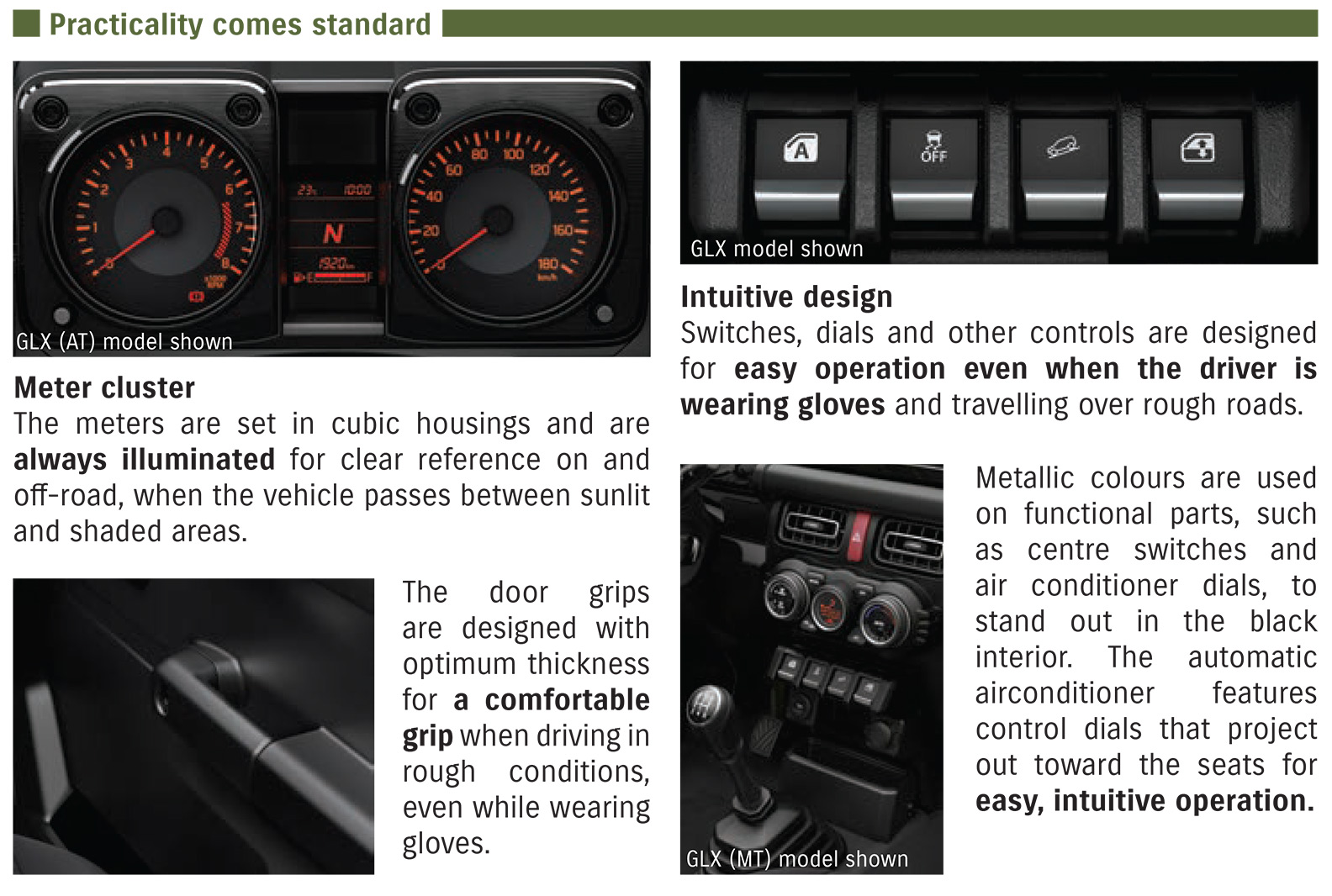
Part of the problem is people will see any technology as excess technology, but what is there is either required to be there or it is done in as good a way as possible while honouring the design philosophy. It’s worth bearing in mind that the car feels simple and oldschool because it’s just designed to be what it is.
Price
This is a particularly emotive topic for people because, in absolute terms, this is the most expensive Jimny. Oftentimes people will recall either a) that they were “$13,000” cars in the previous generation or b) that they launched under $30,000 on the road (albeit for a white manual).
This is sort of true, but the reality is that in a new or near-new car, they still are about the cheapest way to get 4wding other than a couple of Chinese dual cab utes. Second-hand if you are willing to look older for other cars then you have more options, but in terms of something relatively new and modern, especially with its capabilities, there are few cars like it.
The other reality is that just being a smaller car does not necessarily make it cheaper to manufacture. Only a small amount of a car’s cost is the raw material cost; they still need two axles and four wheels and each corner needs suspension. Size is not always as correlated to price for a car as people mike think.
The question about price is better considered around value, especially because the simplistic view of the car being the most expensive Jimny misses how the car world has moved on. It deserves its own section because price doesn’t necessarily represent the whole view of a car’s value.
Value
Historic context
On one hand people are correct to state that a Jimny is now, in absolute $ terms, more expensive than previous models.
The first vehicle in Australia named a Jimny, the previous generation 3 vehicles, launched at a starting price of $16,950 for the equivalent of a lite, $18,750 for the higher specification car in a manual or $20,250.
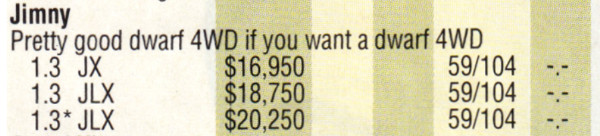
Adjusting for inflation, in 2026 terms this becomes $35,332 for a lite all the way through to $42,211 for an automatic. That’s about the same as the driveaway MY2026 model pricing, which runs from $36,490 for a lite through to $40,990 for a 3 door automatic. 5 doors are $40,490 for a manual and $42,990 for an automatic. (Note all of these base prices are for the free colour of white; other colours are more expensive, exact expense depends if it includes a black roof or not).
There have been some price hikes in the generation 4 Jimny’s run, initially to offset rising costs and also driven by high demand, and then on the introduction of the MY2026 3 doors there was a further price rise. The Jimnys also changed to driveaway pricing, at least for markets that Suzuki Australia serves, in the middle of 2024. To allow for comparisons, I have calculated pricing before onroad costs and dealer delivery even for the driveaway pricing.
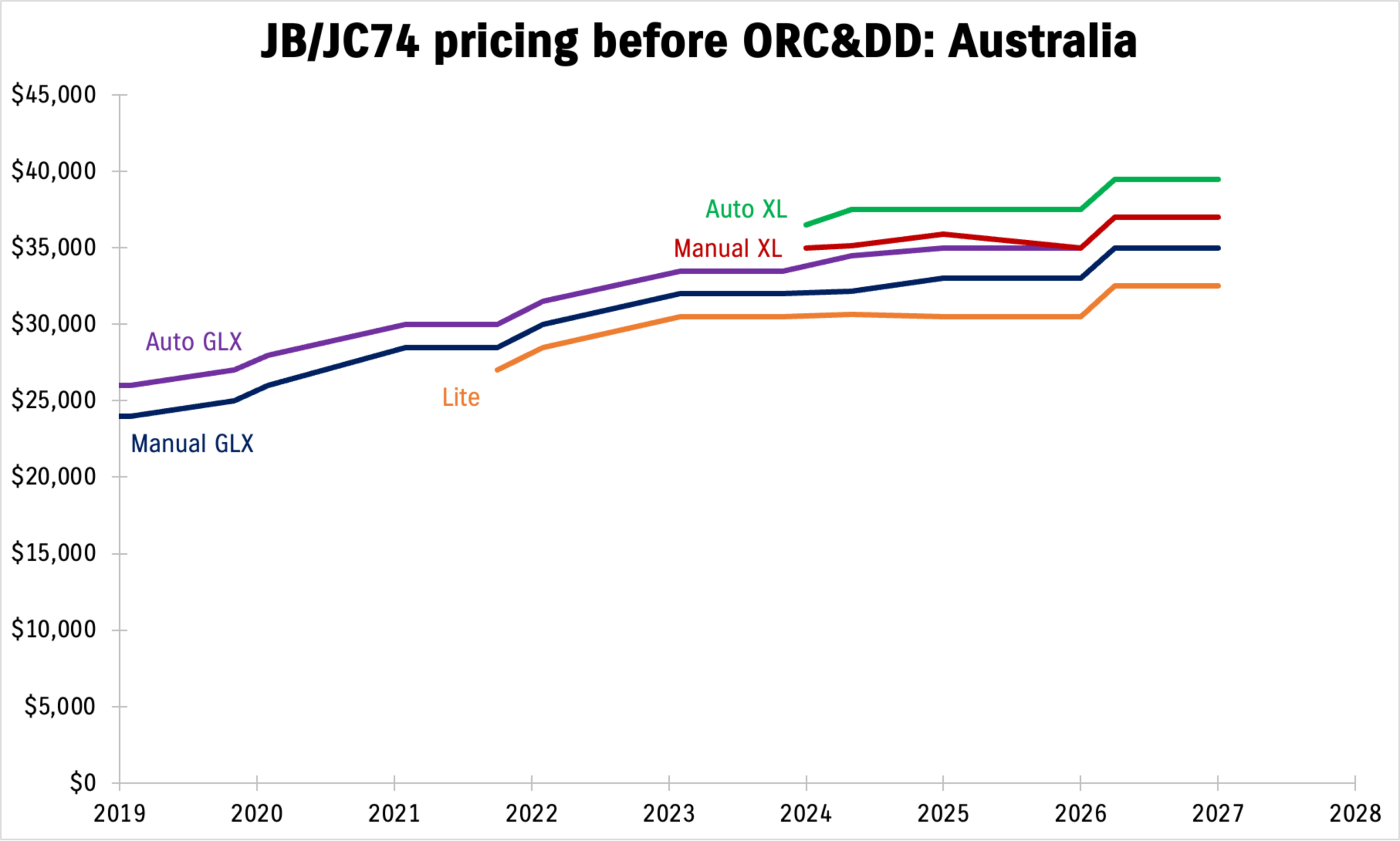
Corrected for inflation, these costs before onroads are surprising steady in comparison to 2019 pricing: while they have risen in absolute terms, overall it’s only just kept up with inflation in Australia.
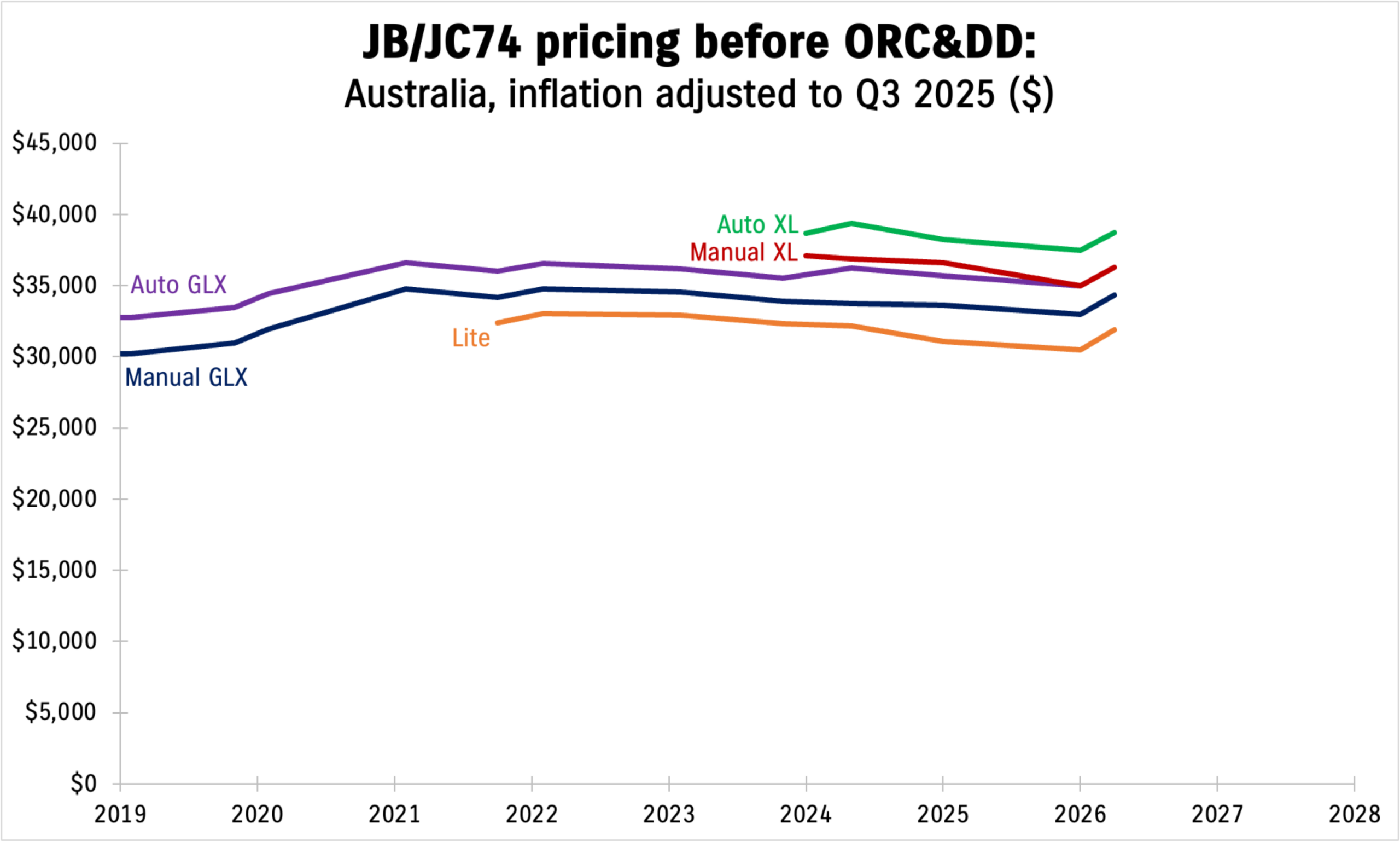
In this context Jimnys are about as cheap as they ever have been, even if they’re the most expensive in absolute terms. The other aspect to consider is that size is not a differentiator here: you can buy a manual 5 door for slightly cheaper than an automatic 3 door, for instance. They run similar infotainment and (relatively) similar safety systems, it really comes down to picking the one that suits what you’re after a bit more.
There are few vehicles out there that compete, especially in terms of size/capability/looks. A Tank 300 might be a similar price for a low spec model but it’s a much larger car and a very different target design philosophy. A Renault Duster might get you 80% of the capabilities and be better on fuel/as a car driving around town, but it’s still way bigger than a 3 door and lacks low range. A lightly used diesel dual cab ute might have depreciated down to match the Jimny’s pricetag but it is a much bigger proposition (both good and bad), plus everything for it like tyres/mods will cost more.
What about used pricing?
The other elephant in the room here is the used pricing, which is really dictated by the market. Earlier in the car’s model run, supply was highly limited relative to demand (especially for automatics). This resulted in very high used prices for lightly used Jimnys.
Whenever a Jimny is listed for sale in one of the many owner groups you will often get price commentary, especially around Jimnys listed for sale higher than they cost new. Sometimes this is higher than even a new price, but often times it is people just lamenting that they haven’t depreciated since their initial used price. Indeed, my own 2019 Jimny is only now just below it’s original price for insurance purposes, even prior to accounting for modifications.
While arguably some Jimnys are listed at ambitious prices, market data compiled by places like the AADA in their Automotive Insights Report (AIR) shows that, in fact, Jimnys do trade above their original base price for even 5-7 years. The February 2026 AIR, latest available at time of writing this article, indicates that a 2-4 year old Jimny retains 109.7% of its original base price and 5-7 year old Jimnys are still at 109.3% of their base price. This residual has steadily been coming down, from a high at the end of 2023 where automatics were at their scarcest. Number of days on sale is also an interesting trend: the cars still clear in about the same number of days (~40-50), with the longest time on sale prior to the introduction of the 5 door models.
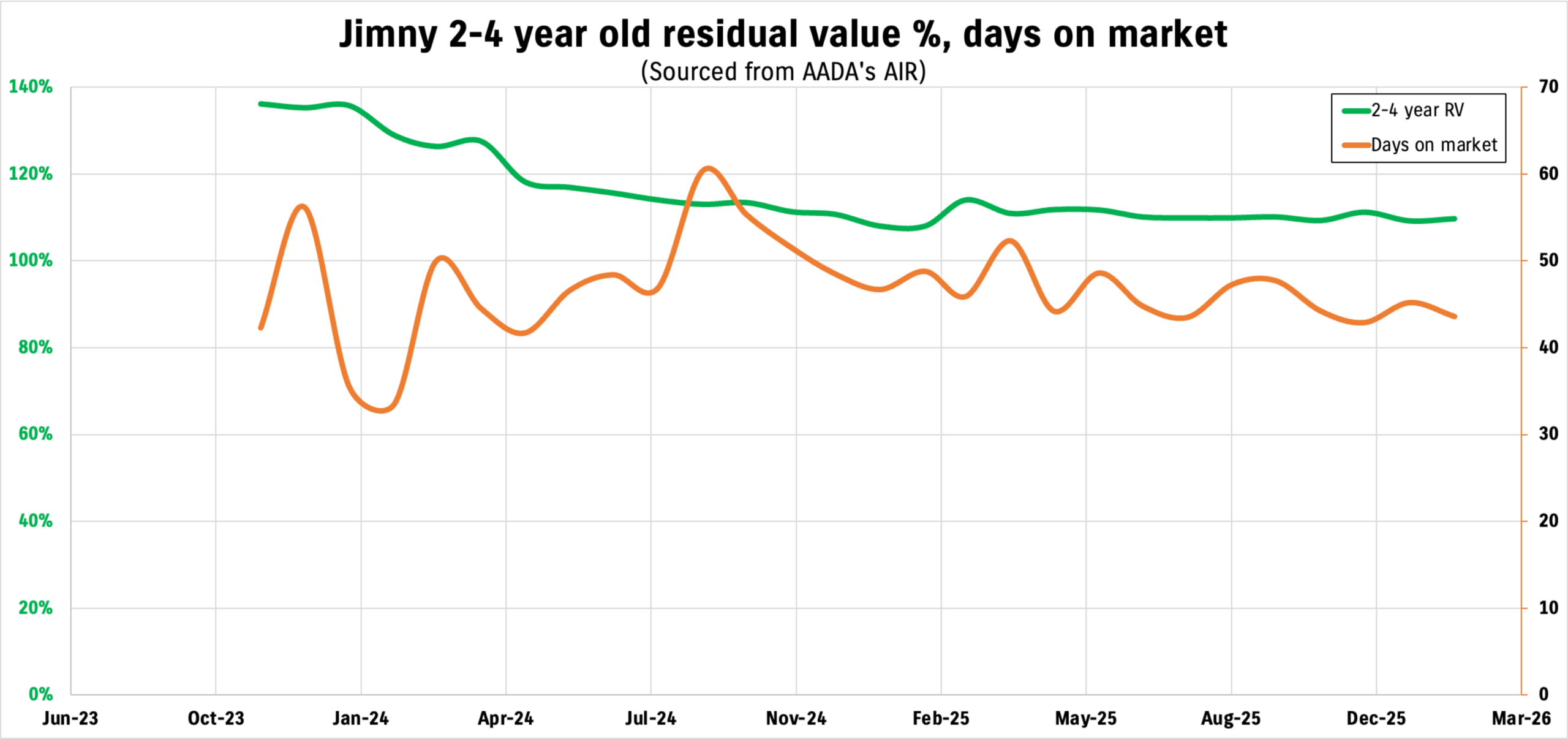
One does have to account for the original base price in assessing this data, e.g. a 5-7 year old Jimny sold at a lower initial price than a 2-4 year old Jimny. In addition, it’s over a range of prices e.g. a manual Jimny selling for 109% of its original price will still be ~$2000 cheaper than an automatic Jimny.
Taking that into account, including the fact that 5 door Jimnys now just fall into the 2-4 year camp, we can bracket the average sale price for a used Jimny in absolute terms.
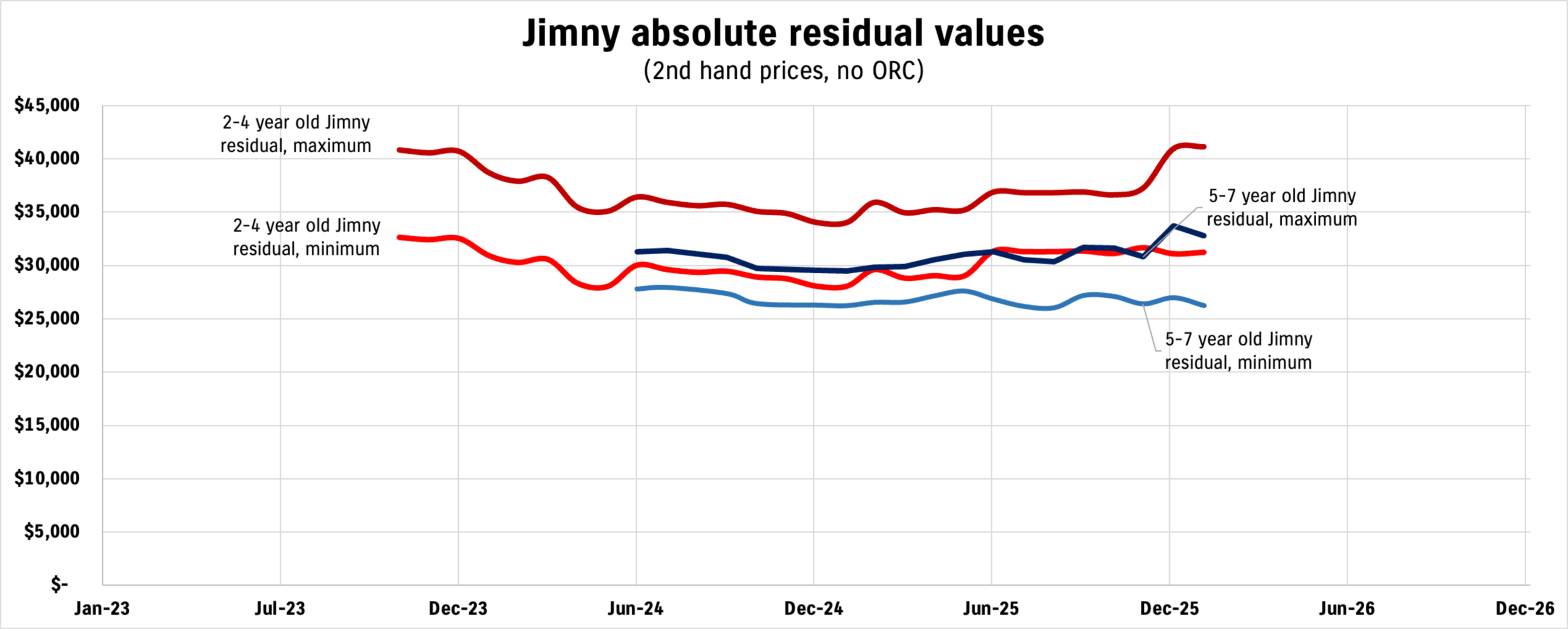
So, yes, Jimnys hold their value and people are just following the used car market to list them at or slightly above their original price (before onroads and dealer delivery costs, that is).
This makes Jimnys phenomenal value. There are few 4wds you can buy at present, drive for 2-4 years, and lose only a minor amount of money on it. Bought a launch petrol Tank 300 thinking it was good value just over the cost of a new Jimny? Your extra $4000 in the purchase price turns into depreciation of ~$10,000-$15,000 over the Jimny in under 3 years.
That’s not to say Jimny prices will hold this high forever, so you should not base your purchase decision entirely on the (current) lack of depreciation. At one point, Sierras (generation 2 Jimnys in Australia) were selling for basically the price of their registration or basically given away. Prior to the introduction of the current generation of Jimnys, the previous generation Jimnys didn’t sell well new and struggled in the used market, too. Both of those models have now seen used prices rise in response to the demand produced by the current Jimny. Automotive tastes change and so the high prices may not persist forever.
In addition, the world is (like it or lump it) moving towards lower fuel consumption and lower emissions vehicles and consumers increasingly are shopping on technology and safety features. The Jimny is the antithesis of that; with limited capacity for hybridisation and a design that will always make fuel consumption and hence emissions challenging, there are signs that the honeymoon may not last forever. Fuel crises, such as the world is experienced in the start of 2026 and is still experiencing at time of writing, also makes them a lot less attractive for a second car over a runabout EV or used plug-in hybrid.
Is it good value?
This is almost impossible for anyone else to give advice to. For me it is, even at the current retail pricing, because I wanted something capable, small, and used the least amount of fuel for that capability. That rules out a bunch of larger 4wds, and I am happy to accept the compromises of how I need to pack for a trip and that it’ll need more enthusiastic driving for highway overtakes.
That value is relative though. If you measure value on the size of car you get then, no, it’s poor value. If you measure value on absolutely every tech feature that can be crammed in then no, it’s poor value. On those metrics it will always fall short, as it will on power and highway comfort.
Hopefully all of the above writing should help guide your thinking to understand the proposition it presents & if the pricing correlates with the value you’d retrieve from it.
Parting thoughts on should you buy one?
I don’t think Jimnys are for everyone. That’s part of what makes them an interesting car.
I also don’t think you have to want to drive one offroad much at all to derive some pleasure from them. They’re fun and quirky and that can be enough to see past the limitations for some people.
If you want offroad ability where you will be the factor that lets down the car’s capabilities more than fundamental limitations of the platform then they’ll be a fantastic purchase for you, too.
If you want something easy to take on long trips without thinking about it, or loaded up with a lot of stuff: either you are going to have to accept other compromises with a Jimny or maybe you do need to think if it’s the right vehicle for you, though.