
Fuel economy
One of the areas that you see people ask endless questions is about the Jimny’s fuel economy. Some people think it isn’t great (in the context of being a little car with a small engine); other people think it’s fantastic (for a 4wd of its capabilities). In addition, the default fuel consumption is displayed as km/L on the dashboard. For many owners this then adds some confusion.
Economy versus fuel consumption
Just getting something out of the way first: by default, the Jimny comes with the dashboard reading km/L. Most readers of this blog will be more familiar with reading fuel consumption in L/100km. While these are interchangable inverses of each other, km/L is strictly speaking a measure of fuel efficiency and L/100km is a measure of fuel consumption. One measures how far you can go for a set amount of fuel, and the other how much fuel it takes for a set distance.
Why most of the world standardised on L/100km but call it fuel efficiency is one of those points of endless debate. Nevertheless, this then means people end up disappointed with the Jimny as they drive in a more careful manner but see the number on the dashboard going ‘up’ rather than ‘down’ so think the car is getting ever worse fuel consumption.
Before you complain about fuel consumption, look very closely at the units displayed on the dashboard for the fuel consumption and see if it has km/L or L/100km denoted.
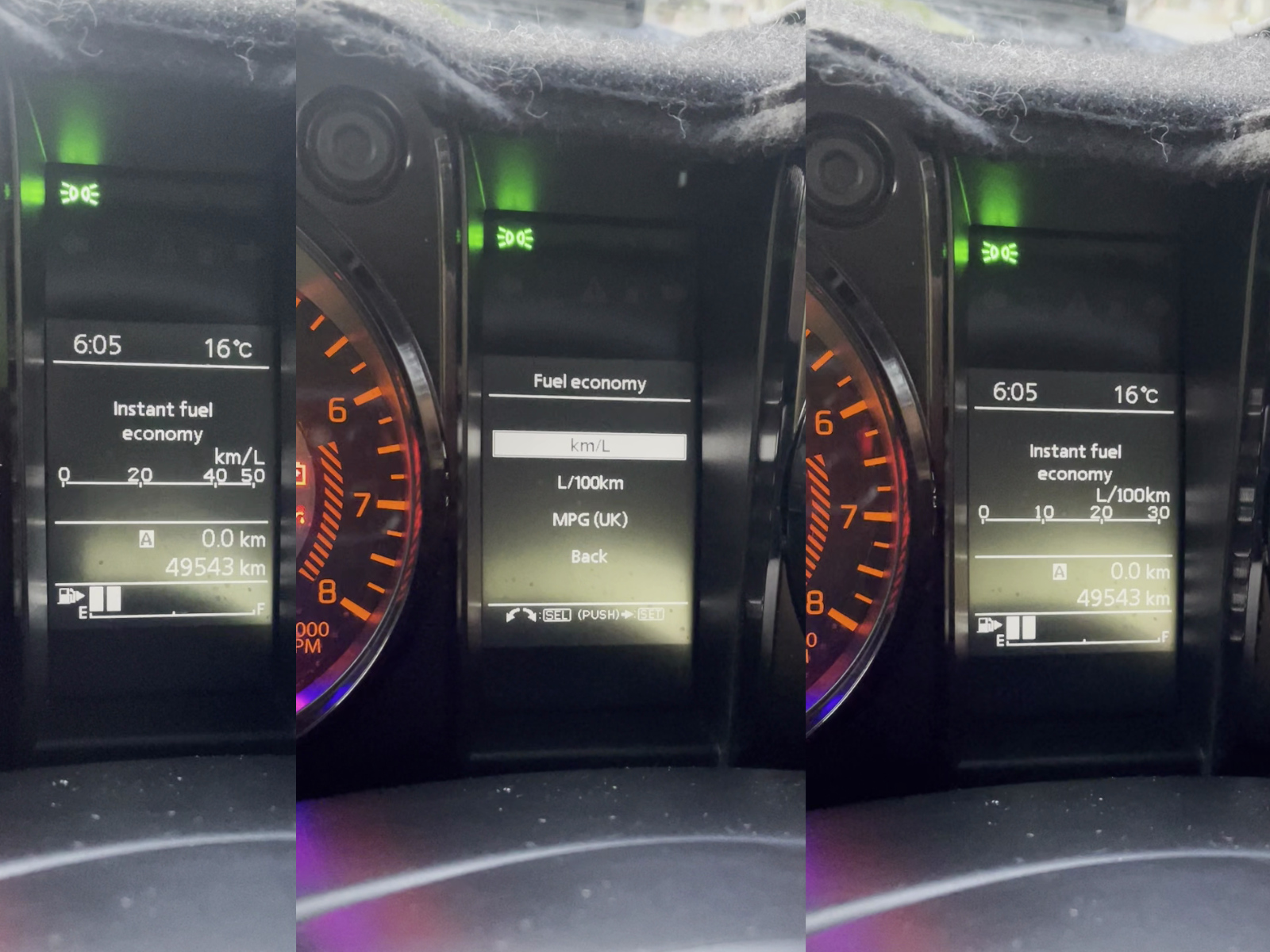
It is a relatively simple change to swap the displayed units using the car’s dashboard menu.
Standard economy
Interestingly, Suzuki don’t publish all of their economy figures. They also nominally provide the same economy between the 3 and the 5 door Jimnys, though there are differences in the CO2 emissions meaning they can’t be the same. Nevertheless, one can back-calculate the slight difference in economy between the different doors. The reported CO2 emissions actually suggest a slightly better economy figure for 3 door manuals (6.3 L/100 km instead of 6.4) when compared to the reported economy directly.
| Model | Combined economy (L/100km; g CO2/km) | Urban economy (L/100km; g CO2/km) | Highway economy (L/100km; g CO2/km) |
|---|---|---|---|
| 3 door manual | 6.4; 146 | 7.7; 176 | 5.7; 129 |
| 3 door automatic | 6.9; 158 | 8.2; 185 | 6.1; 143 |
| 5 door manual | 6.4; 148 | ||
| 5 door automatic | 6.9; 161 |
WLTP data is perhaps more instructive as they have multiple speeds measured for a stock car and are more representative of what you will see in different settings. This is only available for the 3 door, officially, though Suzuki New Zealand use WLTP data for comparable CO2 g/km emissions reporting.
| Model | Low speed | Medium speed | High speed | Extra high speed | Combined |
|---|---|---|---|---|---|
| 3 door manual | 8.2 | 6.7 | 6.9 | 9.3 | 7.9 |
| 3 door automatic | 9.8 | 7.6 | 7.7 | 10.0 | 8.8 |
Basically, the autos will get about 8% worse fuel economy than the manuals, and 5 doors will get slightly (~2%) worse economy than a 3 door, at least based on the published figures. However, in the real world, cars rarely get their published figures. Once you start modifying the car you will also see different economy due to a number of factors.
Real world economy
I am basing this on my own experiences over 7 years; other people’s economy will vary. I mostly have also based it on my typical driving which is a mix of urban and free-flowing 80-100 km/h zones.
When my car was standard I got very high 6L/100km to low 7L/100km, so closer to what is specified for the automatic. Adding a bullbar and changing to 215/75-15 tyres on steel rims took it to mid to higher 7L/100km; adding 29″ tyres on alloy wheels with the other mods the same netted me 8.5-9L/100km on the dashboard so about 8.5L/100km real world economy once tyre size is corrected for.
Most people’s results are similar to slightly worse, but it’s very difficult to standardise for the type of driving. Given how much the Jimny is affected by high speed zones due to its aerodynamics, plus the impact of multiple modifications, I also wouldn’t focus too hard if you’re seeing worse economy than someone else reports.
Factors that effect economy away from a standard car
I’ve tried to break down these factors so we can come up with some rough rules of thumb to get an idea about fuel economy variability and to help people understand what downsides certain modifications or otherwise might have.
Different types of driving
As alluded to above, different types of driving will affect economy and potentially considerably. However, unlike many larger cars (with larger engines), the Jimny struggles with high levels of aerodynamic load so full highway runs at 100-120 km/h will see much worse economy than at 80-90. On the very open road sitting at 110 km/h I will see 20-30% worse fuel economy, knocking it back even to 100 is a reasonable decrease and the sweet spot seems to be closer to 90ish. Your best will probably be constant speed running around this speed to slightly lower. This also matches the WLTP data, where if you plot it based on average speed of the 4 cycles you can see it clearly reaches a minimum somewhere a bit above 80 km/h and probably below 90 km/h.
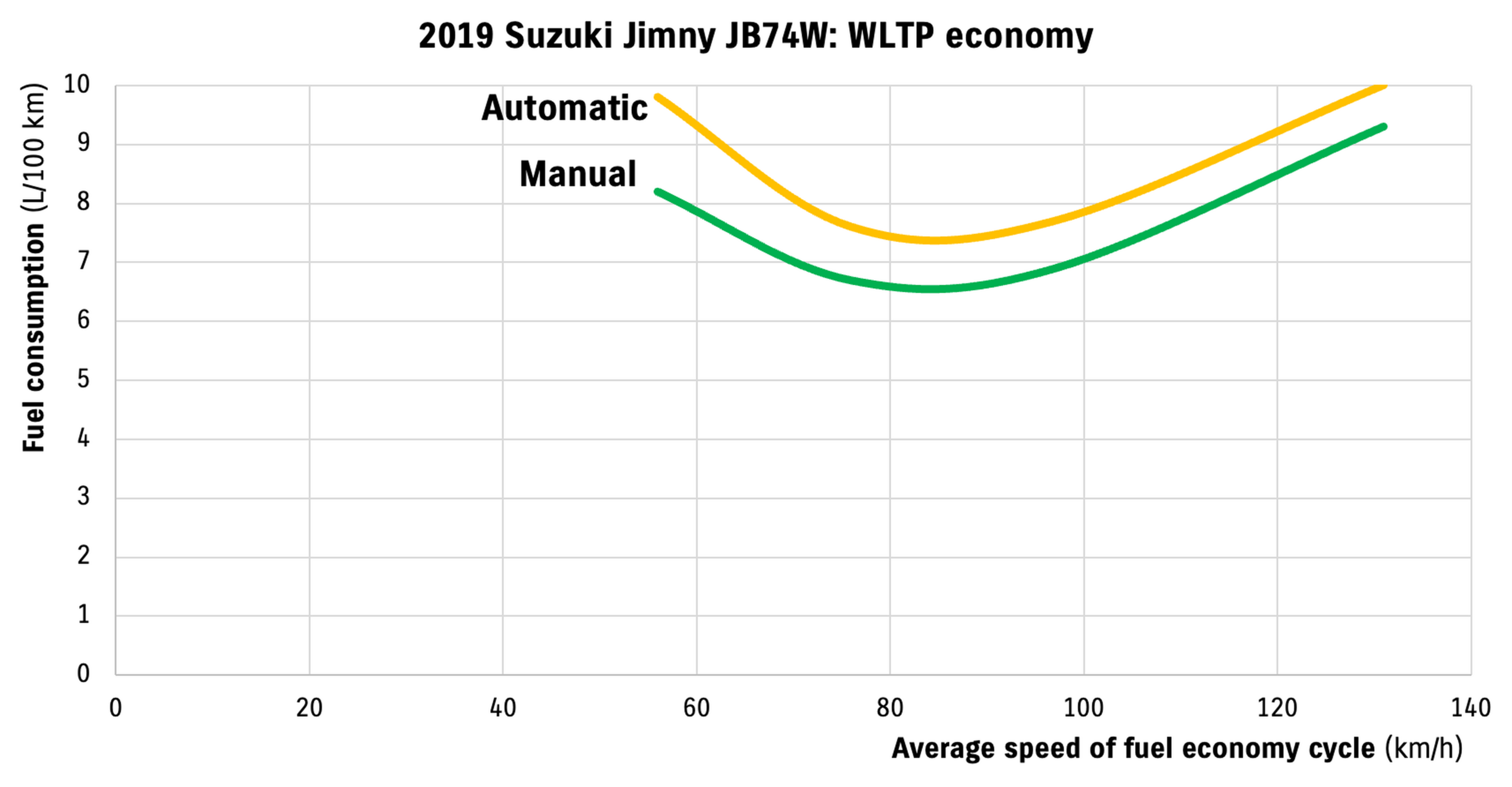
An obvious trend here is that the automatic is more inefficient around town, which I suspect is down to the longer gearing of the 1st gear and one fewer gears to pick from; both can use all gears from about 60 km/h so the manual’s extra gear probably helps in ratio selection in some of the mixed speed sections of urban testing.
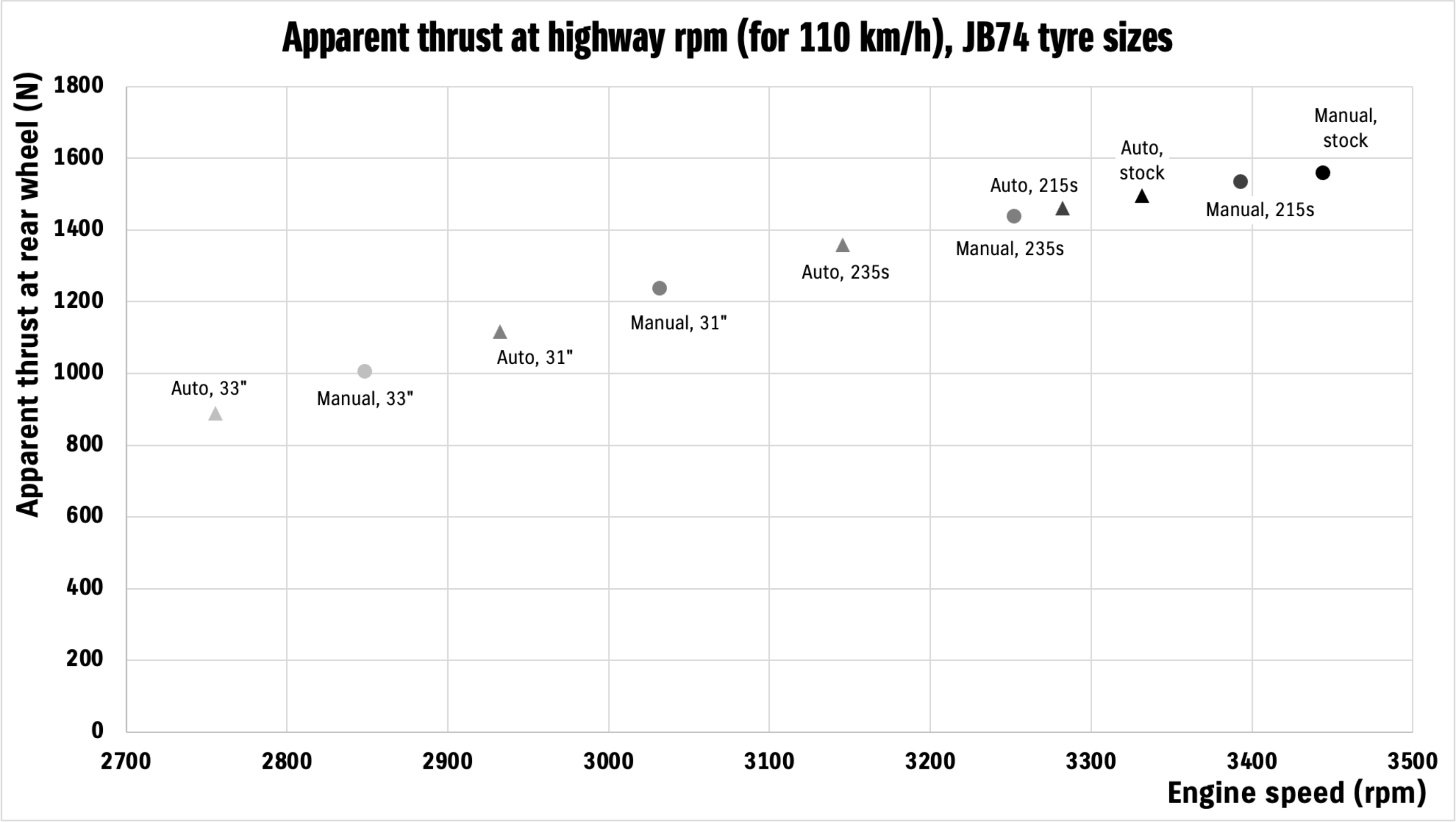
People tend to make the assumption that it is the high revs that result in the poorer economy at full highway speeds, but the reality is the engine is geared about as well as it can be for the standard levels of power. In that link I explore a hypothetical longer top gear; ultimately, it can’t really be any longer and make the car get better economy. We’ll touch on this in a bit but it means that modifications that drop your engine speed at highway speeds will not see an improvement in fuel economy and in fact will make it worse since you have more load to achieve the same effective power.
What is hurting you on the highway is the aerodynamics, and there’s not really much you can do about that since you bought something with the aerodynamics of a brick.
Ultimately you can think of it like this:
- Constant speed, 80 km/h zone = best economy you’ll get
- City driving will be 10-20% worse than that
- Highway driving 90-100 km/h will be 10-20% worse than your best
- 100+ km/h will be another 10% worse than that
- 115+ km/h will be another 10% worse again
Standard with a manual that might mean you go from 6.8-6.9 L/100 km in nice relaxed slightly mixed driving to mid 7L/100km driving around town, high 7s to 8s on slower highway runs and 8-9L/100 km if you’re sitting on the Australian highway limit: and, just to note, that’s before you account for transmission differences or the heavier weight of a 5 door car.
A huge factor here when you are trying to understand if your fuel economy is acceptable is that people are not very good at characterising their fuel economy in terms of the exact type of driving they do. Many people will say they do highway driving, but it’s more at commuting time so it is free flowing but also not at the full open road highway speeds that would reduce economy. Alternatively, one person’s stop-start traffic might be something you regard as free-flowing or vice-versa. Bear this in mind when you are comparing against what other people say.
Wheel and tyre changes
A huge thing that effects fuel economy is changing wheels and/or tyres. There’s a few factors at play here:
- Almost all tyre changes, let alone wheel changes, will result in a heavier wheel/tyre combination.
This affects predominantly stop-start traffic due to the higher rotational inertia. - Most tyres people go for are designed for more offroad use.
This gives them worse rolling resistance characteristics (so you have more inherent drag) but also their chunkier tread pattern will have worse aerodynamics. Offroad biased tyres are also often noisier; that extra noise is energy that, ultimately, is coming from fuel you are burning: it is one part (but not all!) of the rolling resistance difference - Finally, a tyre change is likely to change the overall size of the tyre which changes the car’s gearing, reducing economy. Even tyres in the standard size can vary in their overall size, let alone once you go to (generally) larger tyres.
Tyre size economy correction
I’ve split this out into a sub-heading purely because it can be a large factor and it will reduce fuel economy.
From my own personal testing, which in 2026 has included going back to standard wheels and tyres from running 205R16/29″ tyres on a 16″ alloy wheel, once you go away from stock sized highway terrain tyres your economy will suffer.
First off, the size.
A change to a 215/75-15 tyre is only a 1.5% change in gearing so doesn’t change fuel economy too much, so its major change is in the tyre tread that we’ll address soon. By the time you’re at a 235/75-15 you’ve changed gearing 6% and there is a corresponding change to fuel economy. Larger than that and without reduction gearing the economy gets worse and worse. The actual reason for this is not just the longer gearing, but also because for a given speed the engine has less torque available, so you need to apply more throttle (and burn more fuel) to make up for this.
In addition to this change though is you also need to understand correcting fuel economy for tyre size differences. Since the car doesn’t know that your tyre size has increased, it doesn’t realise you have travelled as far as you have. Thus the reported fuel economy by the car or calculated using fillup volume & odometer reading will be off by the difference in the tyre size compared to standard. The amount you have to correct depends on the change in tyre size:
- 215/75-15 is a 1.5% change
- 235/75-15, 205R16 or other 29″ tyre is a 6% change
- 30″ tyre is a 10% change
- 31″ tyres present a 14% change
- 235/85-16 is a 16% change
- 33″ tyres are a 21% change
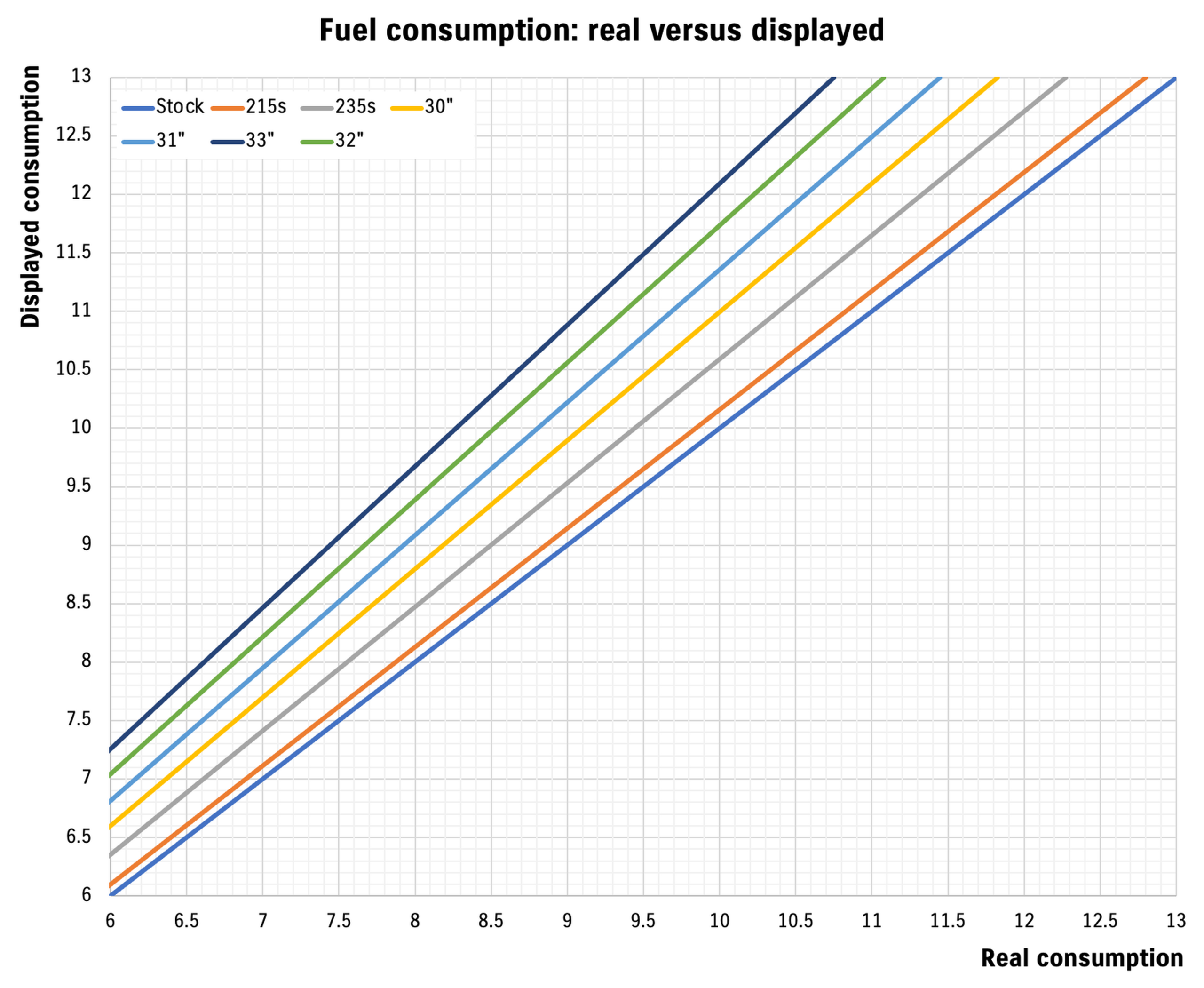
To use this graph, locate what your dashboard is saying along the bottom axis, slide up till you hit the line that corresponds to your tyre size and then go over to the left to read off what your actual fuel economy is. If the dashboard reads 10 L/100 km and you’re running 235/75-15 tyres? Well, good news: you’re ‘only’ at 9.4 L/100 km actual consumption.
Personally, I just take 215s as the dash reads, for 235s knock off about half a litre/100 km and 31s knock off around 1 L/100 km from what it reads as a mental correction factor.
Tyre tread pattern is the other factor, along (potentially) with tyre weight in city/urban settings.
The factory Bridgestone D684II tyres in 195/80-15″ rank as European consumption labelling ‘C’ rating, and a noise rating of 71 dB in standard testing. In the same standard size, a Toyo Open Country R/T 2 ply is D (worse), noise of 73 dB and a BFGoodrich KO3 is E (even worse) and noise of 74 dB. That extra rolling resistance and added noise energy takes up energy, which means more fuel consumption.
Tyre weight will also have a small impact, though mostly in urban settings where you are accelerating and decelerating the tyre. The key element here is the moment of inertia; if we assume we’re on the same wheel as standard then only the tyre’s mass change affects the moment of inertia.
- A standard D684(II) @ 9.8 kg has a moment of inertia of 9.8 kg * (0.693)^2 = 4.7 kg.m^2
- A Toyo Open Country R/T 2 ply @ 11.2 kg has a moment of inertia of 5.4 kg.m^2 (+15 %)
- A BFGoodrich KO3 in the stock size @ 17.1 kg has a moment of inertia of 8.2 kg.m^2 (+74 %)
Moment of inertia means you have to put in more energy to spin up the wheel, though it also means it resists slowing down more. This means on the highway once you’re up to speed it’s less of a penalty, but it definitely is a penalty for fuel consumption getting up to speed.
Note here that mass of the tyre matters less than the radius of the tyre, so going bigger hurts you more from a flywheel acceleration perspective than a change in mass does. That’s the theory; however, a legal tyre change in Australia is around 6% radius change. A 6% radius change produces about 12% increase in moment of inertia. As you can see above, it is possible to get tyres close to double the weight of a stock highway terrain tyre just in the stock size alone so mass is the key element.
Suspension changes
Suspension changes by themselves won’t really hugely affect fuel economy, though some people report differently. From people I know with higher suspension but stock tyres, generally they’ve ended up with about the same change. The difference is mostly down to people driving the car harder with upgraded suspension, or the suspension being fitted with upgraded tyres that will change fuel economy, as discussed above.
Theoretically there will be a slight change in aerodynamics with the car being taller & a bit more space underneath to develop vortices but it’ll be a lower order effect than other things like tyre changes etc.
Bullbars
Now this is something which will change economy. Bullbars add weight, which will adversely affect fuel economy in stop-start traffic as you have more weight to accelerate. In addition, bullbars will be less aerodynamic and so will make fuel economy worse on the highway, as well.
How much is really difficult to say. I probably saw a highish fraction of a L/100 km when I fitted my ARB bullbar but the car was otherwise standard, maybe 0.2-0.3 L/100 km in mixed driving. With my car lifted, 75,000 km older, and back on standard wheels I can still get around 7 L/100 km economy so not really too much worse than when the car was completely standard and I could get just into the 6 L/100 km range.
Roof racks and awnings
This can actually change fuel economy a lot, especially on the highway: mostly this will be due to added aerodynamic drag. Some roof platforms can weigh a lot, not far off the added weight of many bullbars, so obviously that will also change your fuel economy around town.
Awnings and things hanging off the side of the car will have a small penalty on the highway; at the ultimate end of the spectrum here if you do end up wanting to do something like a roof top tent, ignoring aspects of the roof load limit aside, then that might be responsible for 1-2 L/100 km worse economy. Large swags tied up on the roof can do the same.
Having recently taken off my Rhino Rack crossbars, I’m about half a litre to a bit more per 100 km better off for doing so. It then comes down to a convenience of taking them off and putting them back on if that saving is worth it for you.
Towing
A final area that will change fuel consumption is towing with the Jimny, and this is actually surprisingly hard to quantify. What it varies on will depend on a few factors:
- Type of towing you’re doing
Long highway runs will depend a lot on the geometry of the trailer (see below) but around town it’s much more around weight. Being mindful of the cost of speeding up again after slowing down will make a big difference in such situations though. - The geometry of the trailer
If your trailer is a lot taller or wider than the Jimny (and most are) then you’ll find much worse economy. People towing teardrop caravans can report economy as bad as 15L/100 km if they’re doing higher speed highway runs with largeish caravans close to the weight of the car. Towing something smaller, like a camper pod trailer, seems to add 1-2 L/100 km but usually people also doing this have knocked off some speed which helps a lot. - Your experience towing
The people who seem to have the best economy are people who are experienced at towing. They’re usually better at anticipating traffic and hills to optimise the economy for a particular journey, and also more likely to pick something Jimny appropriate. Trying to drive just how you would without a trailer, while towing a large trailer, is a recipe for much worse fuel economy.
Wrapping it up: what sort of consumption should I expect?
This is all predicted on mixed condition urban driving, but:
- Standard manual 3 door: around 7 L/100 km
- Standard automatic 3 door: around 7.5-8 L/100 km
- Standard manual 5 door: around 7.5 L/100 km
- Standard automatic 5 door: around 8-8.5 L/100 km
Modified with offroad tyres in roughly standard size (i.e. 195/80-15 or 215/75-15)
- Standard manual 3 door: around 7.5 L/100 km
- Standard automatic 3 door: around 8-8.5 L/100 km
- Standard manual 5 door: around 8-8.5 L/100 km
- Standard automatic 5 door: around 8.5-9 L/100 km
Modified with bigger tyres:
- Standard manual 3 door: around 8 L/100 km
- Standard automatic 3 door: around 8.5-9 L/100 km
- Standard manual 5 door: around 8.5 L/100 km
- Standard automatic 5 door: around 9-9.5 L/100 km
Modified with bigger tyres and a roof rack:
- Standard manual 3 door: around 9 L/100 km
- Standard automatic 3 door: around 9-9.5 L/100 km
- Standard manual 5 door: around 9.5 L/100 km
- Standard automatic 5 door: around 10 L/100 km
Add another L/100 km to those numbers for higher speed runs on the highway at closer to 100 km/h and I think that covers most of where most people are at with the current generation Jimny.
Just remember, the A in Jimny stands for aerodynamics and the F in Suzuki stands for fuel economy.
Range
A big element here is tank size, and specifically when you get warnings with the car. The Jimny has two different low fuel indications:
- With around 8-10L left in the standard tank, a fuel light comes on.
The dashboard centre display also has a LOW FUEL LEVEL warning, and when you start the car a chime will also sound. - With around 5L remaining, the final fuel gauge bar will flash.
There’s no other change here but it’s the indication you’re getting quite low in the tank.
The challenge here is the first warning represents about 25% fuel remaining and the second 12.5% left. The warnings are set so they represent a fairly typical car ‘range’ after you get a low fuel indication, but it represents a relatively large proportion of the total tank capacity.
Understanding how much fuel you have left when you have the fuel light come in is quite useful in planning long distance or remote area travel. The Jimny is somewhat a car where you have to push past your instincts about refuelling as soon as the fuel light comes on if you need to stretch out the range.
Long range or auxiliary tanks
Speaking of stretching out the range, now’s probably a good time to talk about changing the fuel tank. I have done this and it would be one of the first modifications I would do if I could afford it. I do live somewhere where there can be long distances between fuelling opportunities and some parts would be inaccessible on the stock fuel tank.