
Generation 4 Jimny history – an Australian perspective
This is part of a broader article going through the history of the Jimny in Australia. Here we focus on the retro-styled and modern technology boasting generation 4 Jimny, built on the underpinnings of the previous generations. Excitement about this model means there’s a bit more literature out there, plus I can more heavily lean on available other sources like promotional brochures and the like
You are here: Australian Jimny History -> Generation 4
Next: Australian Jimny History
Previous: Australian Jimny History -> Generation 3
Sections
- Announcement and fanfare
- Design and target market
- Updated safety features
- Second-stage manufacturer GVM upgrade
- Sales figures
- LWB generation 4
- EV generation 4
- Heritage edition: March 2023
- MY2026 updates
Announcement and fanfare
The generation 4 Jimny was announced in 2018, with delivery from late January 2019 in Australia.

The first road test articles didn’t really start appearing until Feb or March 2019.
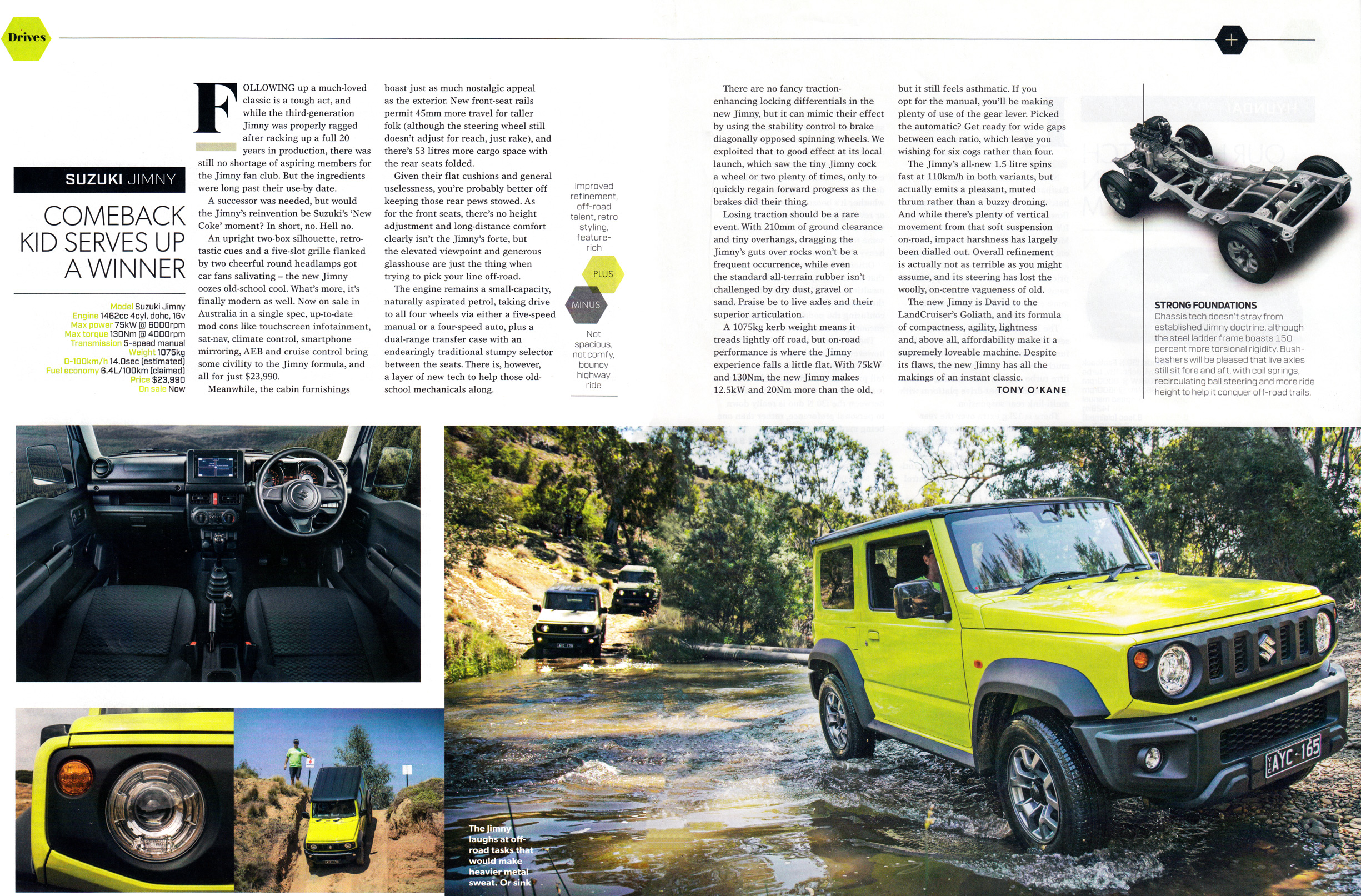
Although this pricing didn’t last long, here’s the launch RRP listing from Wheels as well. Note that the first price rises occurred on RRP in ~Sept 2019, but low availability meant they were already fetching $35 000 as near new used cars.
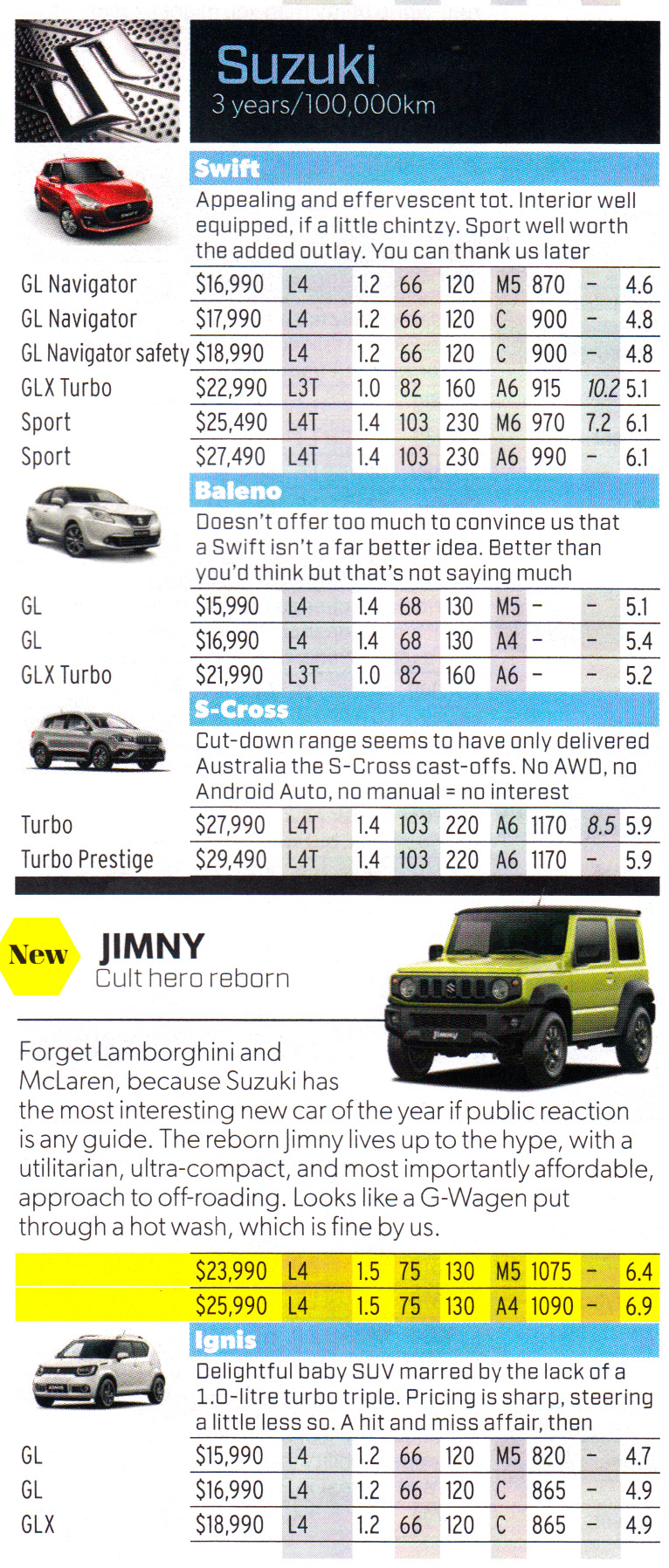
Design and target market
Although these launch articles are fine, they don’t really go into the nitty-gritty of the details of the car. Certainly I found brochures were hard to find when deciding if I wanted one, so I’ve made it my mission to document how certain things chose to be done for the gen4 Jimny.
The most definitive statements about the design and genesis for this generation outside of press articles with limited details come from South African training materials where the target market and the design rationale are spelled out.
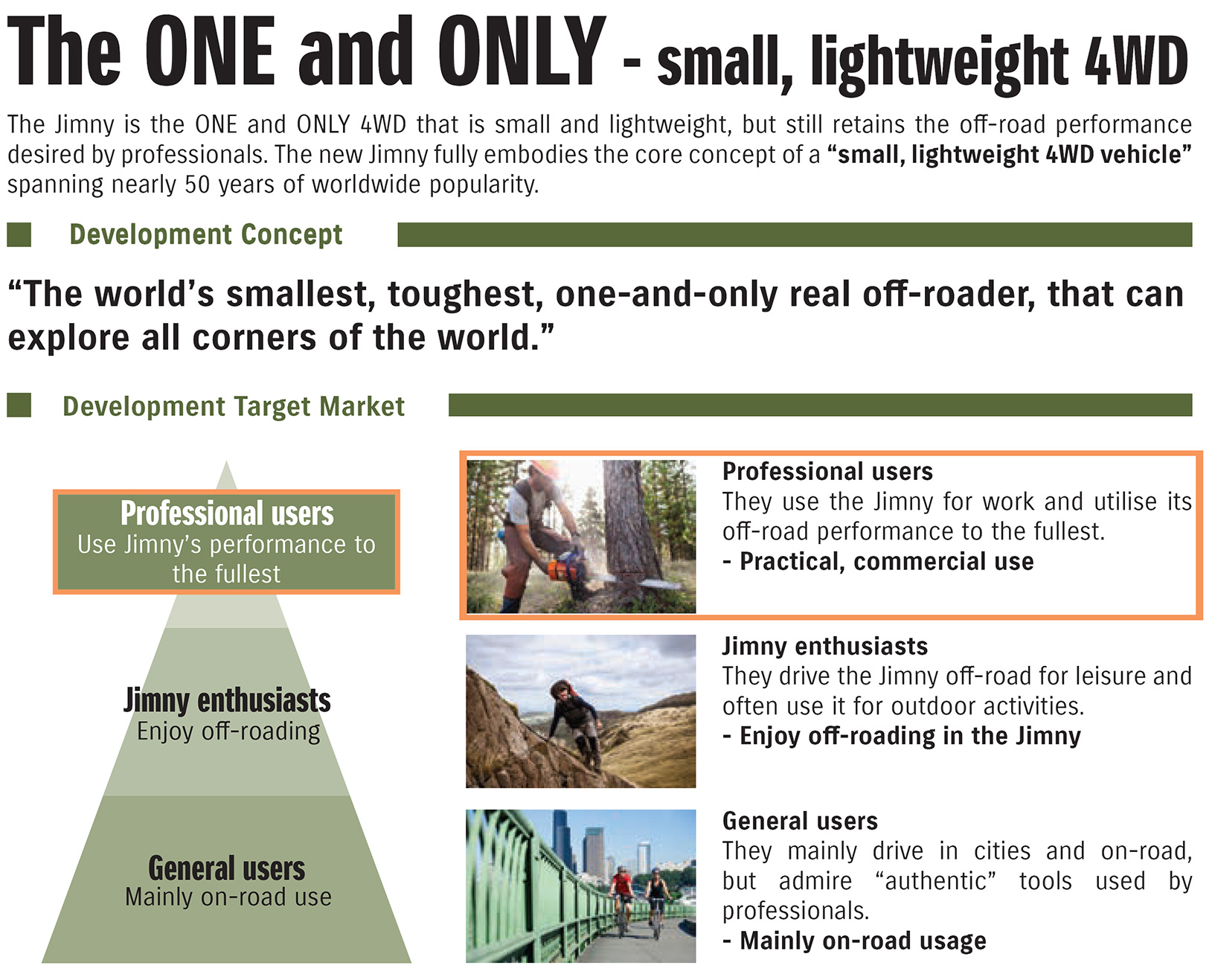

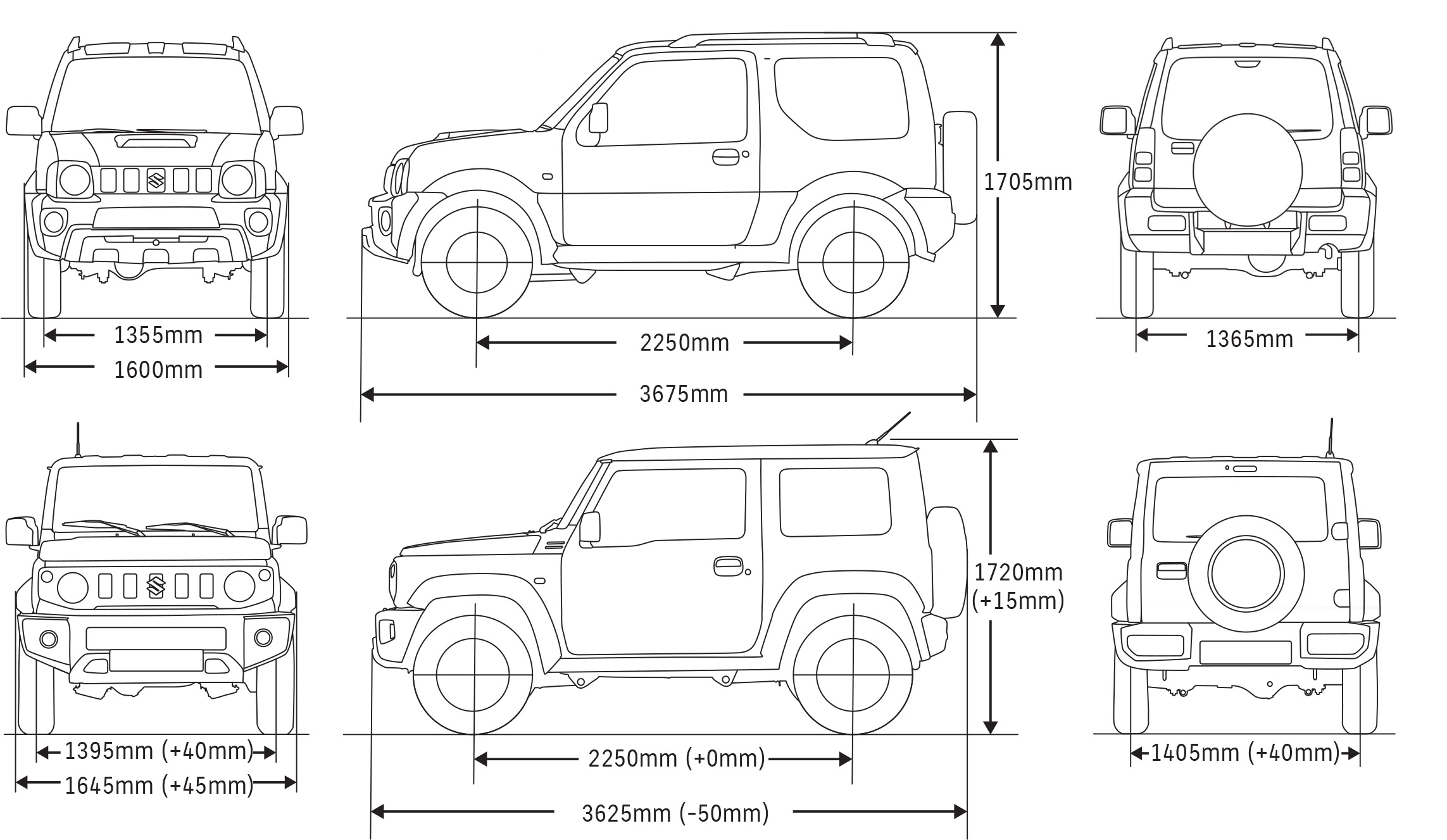
Dimensions compared to generation 3
The dimensions of the new Jimny are revised compared to the 3rd generation. The car is taller, is wider and with a wider track, but shorter. There is more ground clearance, mostly through the provision of newer taller but narrower tyres (195/80-15 instead of 205/70-15), and the revised dimensions coupled with this added ground clearance gives greater approach, departure and ramp-over angles compared to the previous model.

There is an excellent media kit that Suzuki Australia put together that highlight the new model’s features and also the original brochure distributed to dealers for training and sales purposes for the JB74 from Suzuki Queensland. Some key highlights out of these media packages are:
Practical design to match the previous generations
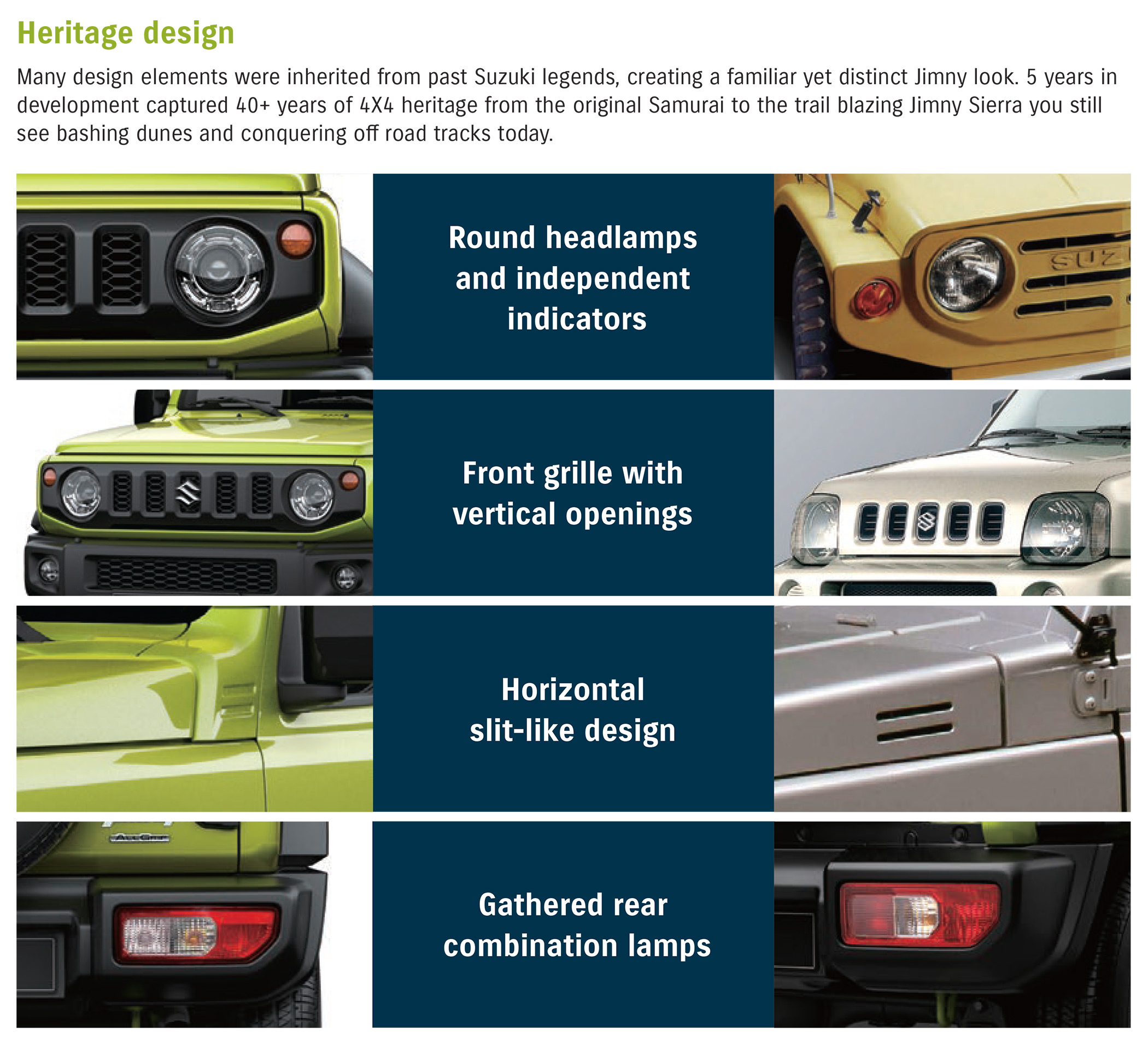
A key element to the 4th generation design are design cues relating to all 3 previous generations.
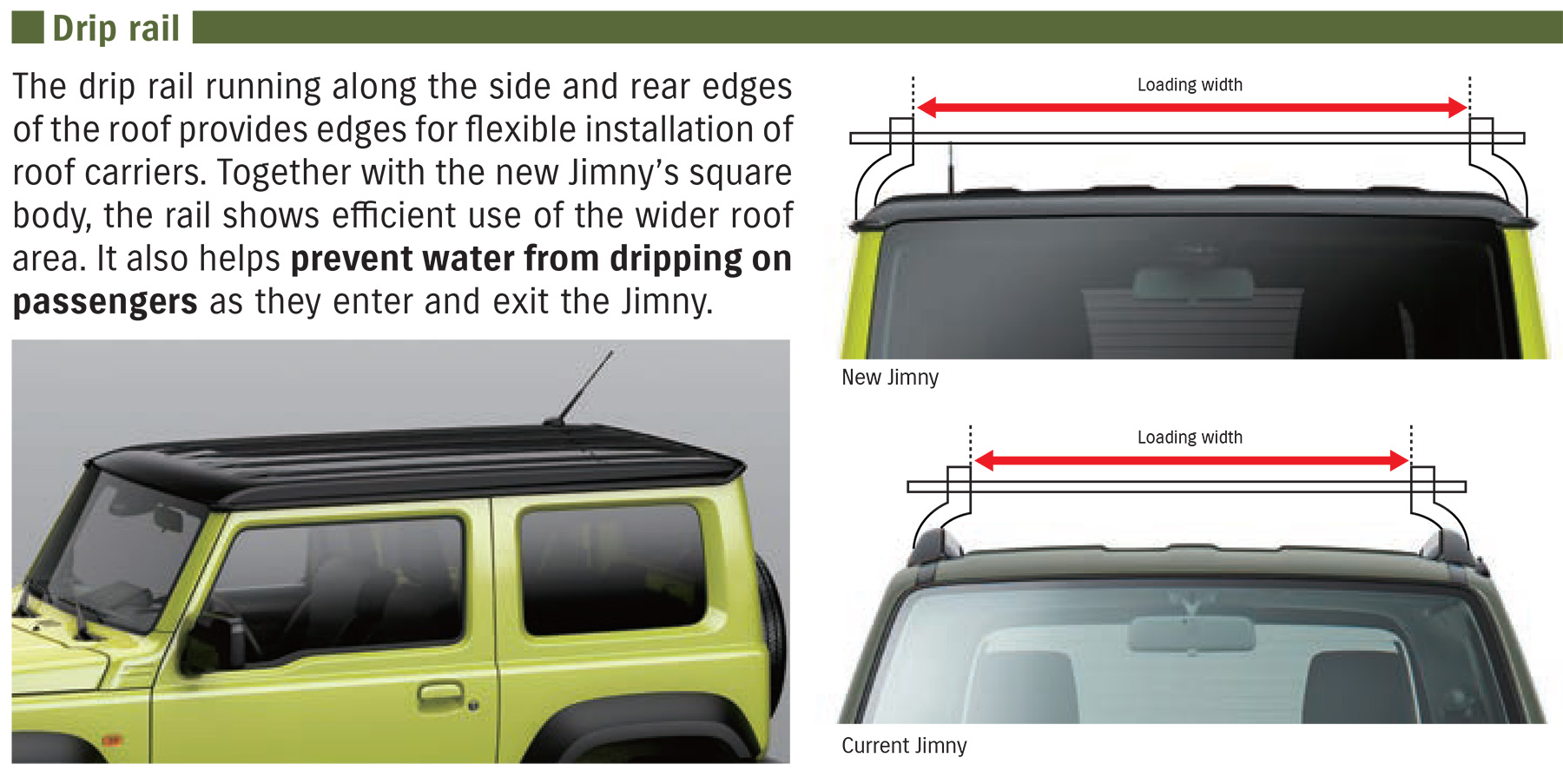
An example of Suzuki’s so-called ‘practical design’ can be seen in going back to the gutters for the roof rather than load rails. These were incorporated to a) widen the loads that could be carried on the roof and b) also to provide better rain protection getting in and out. I think they succeeded at point a, but point b doesn’t totally bear with my experience of my JB74 in the rain…
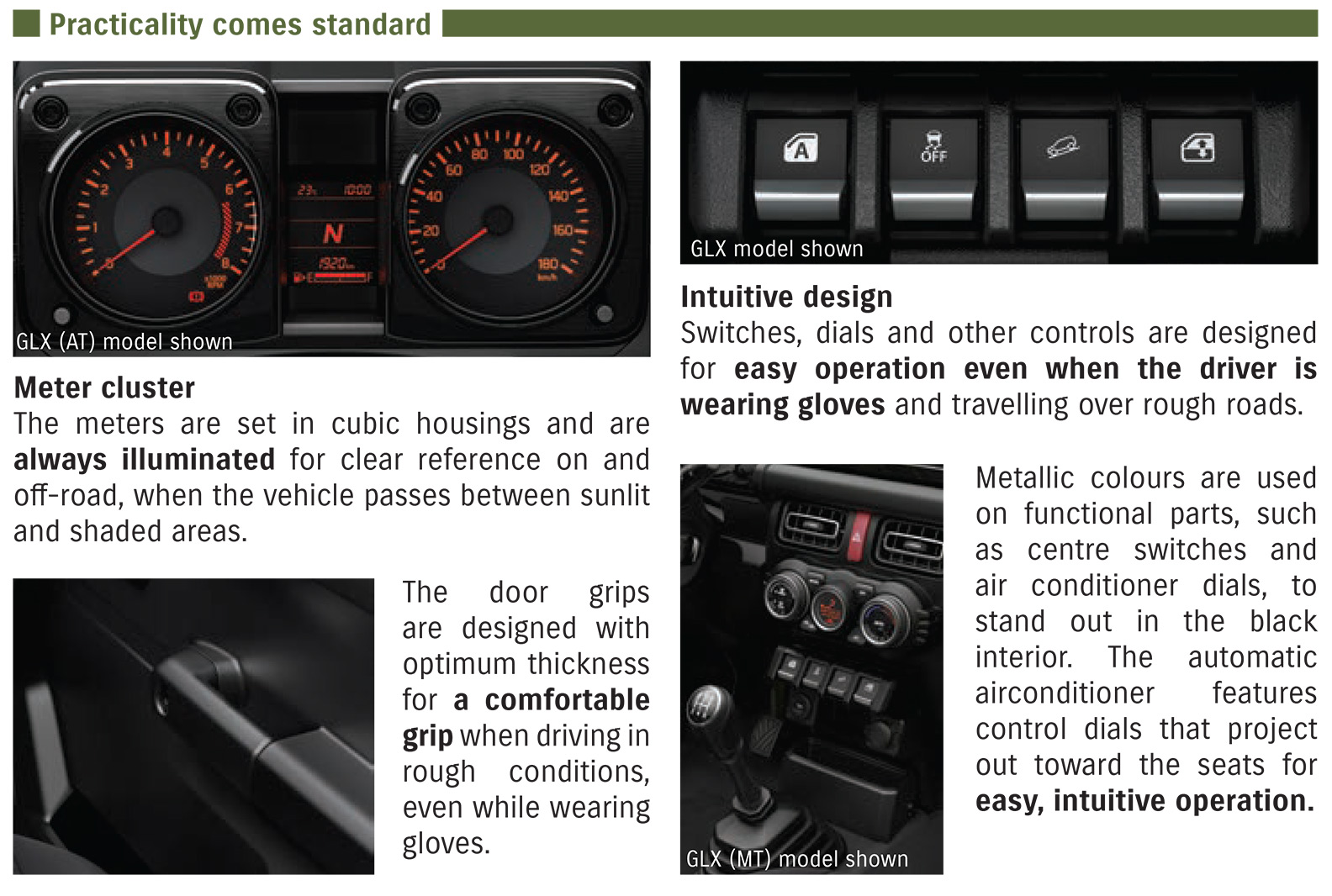
A more practical interior
A key design element referred to in all of the marketing brochures and training material is about how all of the controls are designed to be used with gloves on to ‘assist the professional users’.
Interestingly, many sales brochures only touch upon the most practical aspects to the new generation: completely lay-flat seats, a departure from the 3rd generation Jimny. Not only do the seats fold flat for luggage loading in the back of the car, making a totally flat surface, but the front seats go further forwards and recline fully to give room to lie down. The extra luggage space is also talked about but little sales info for consumers talks about this or expands upon it. Again, this relies on the South African training material for sales people.
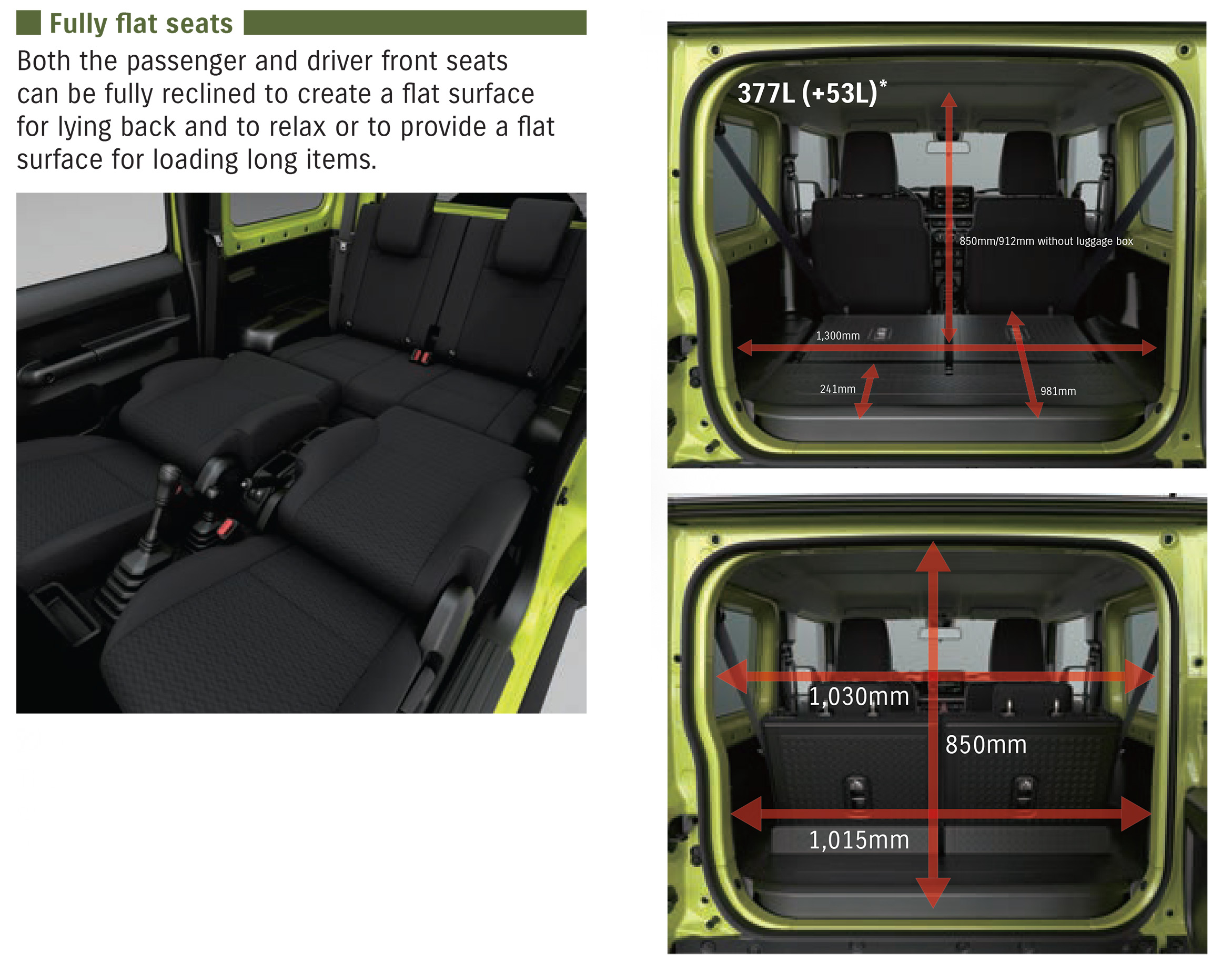
Fold flat seats and also the larger rear door opening and the room available with the rear seats folded down and up out of the South African training material on the New Jimny, 2019
Brochures all alike do point out how the front seats adjust further and with more positions to help people get a good driving position, and the seats are sculpted narrower at the top to make it easier to turn around and look backwards when using the car around town or off road.
Retaining or enhancing off-road performance
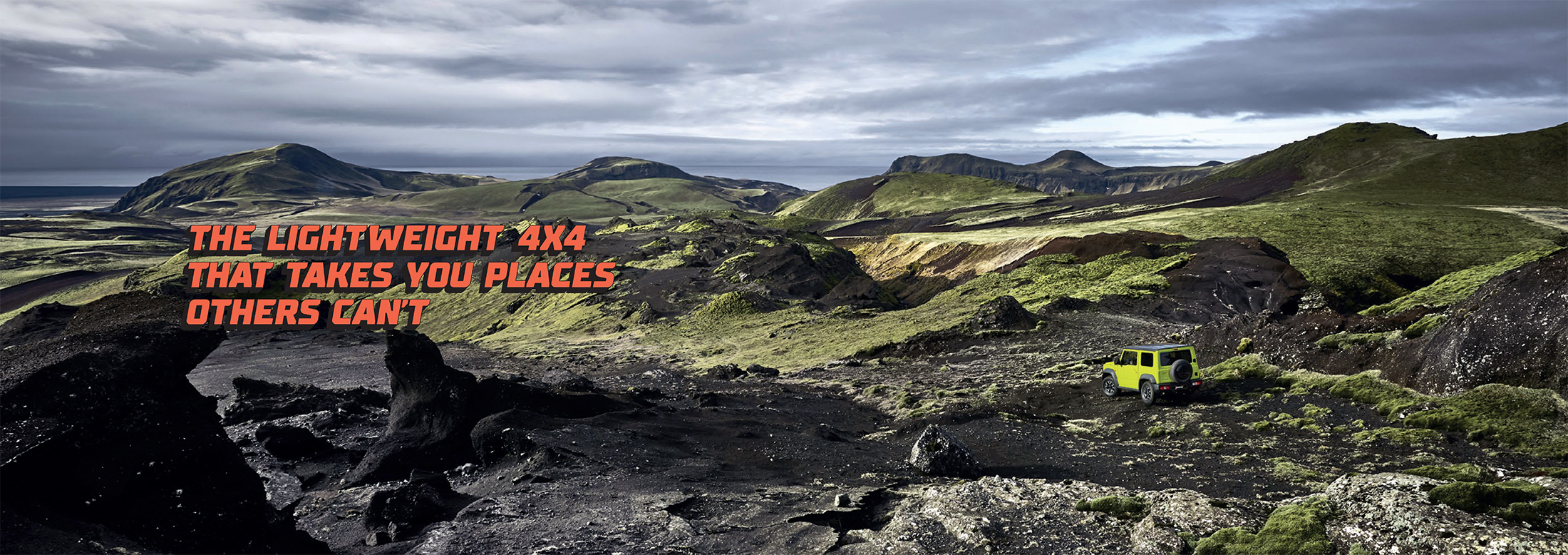
Speaking of off-road, a key selling point to Jimnys throughout the ages has been their non-compromise offroad performance. Since the launch of the 3rd generation, all of the small 4wds with ‘real’ offroad capability have been softened, so this was a market segment the 4th generation could fit into.
A large area of the selling point of the generation 4 Jimny are the extra things for offroad, namely the ability to do stronger individual wheel traction control including in low range, and also the newly introduced hill descent control.
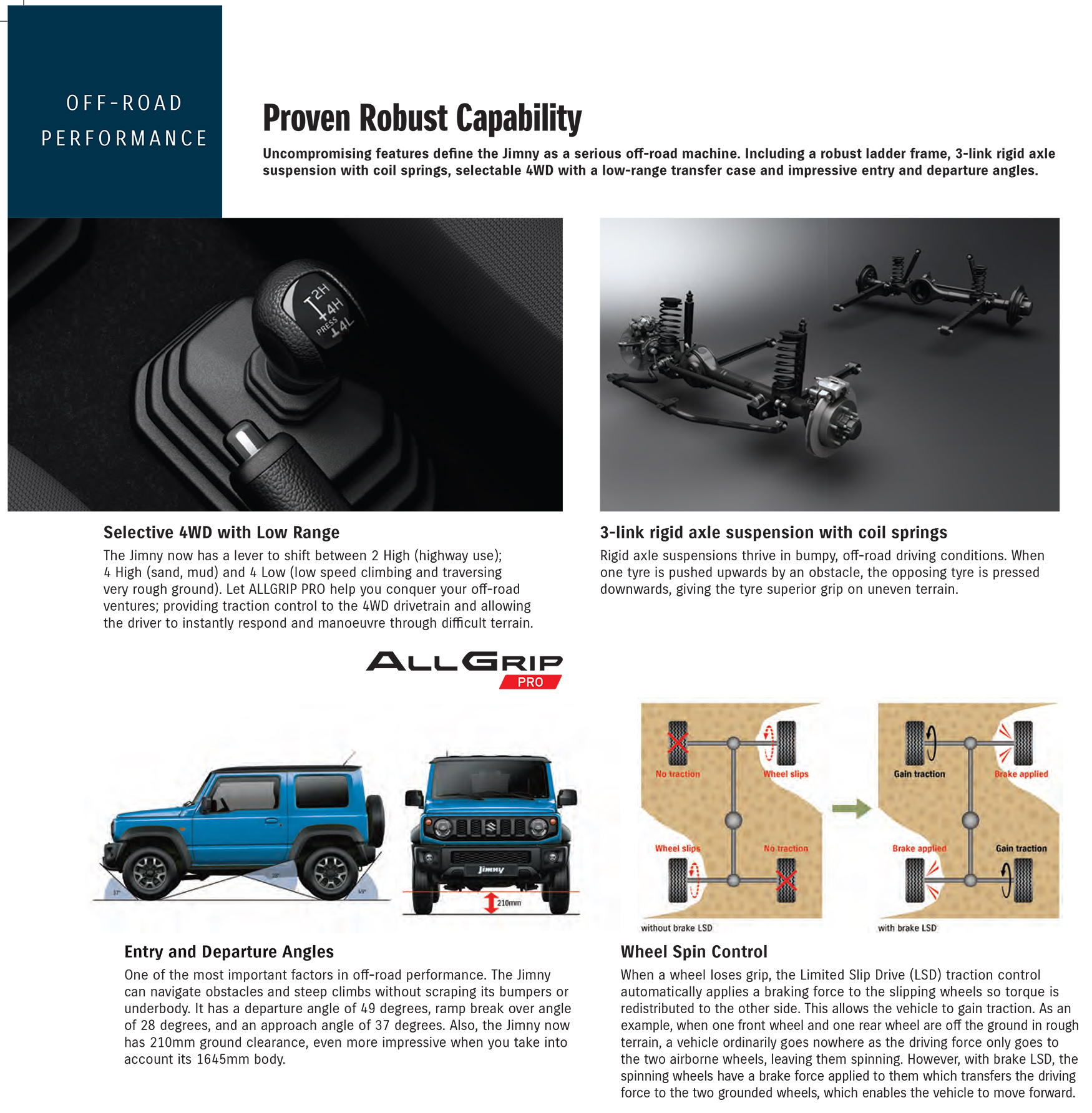
The enhanced brake LSD performance compared to late model gen3’s is demonstrated in this video:
Strengthening underneath
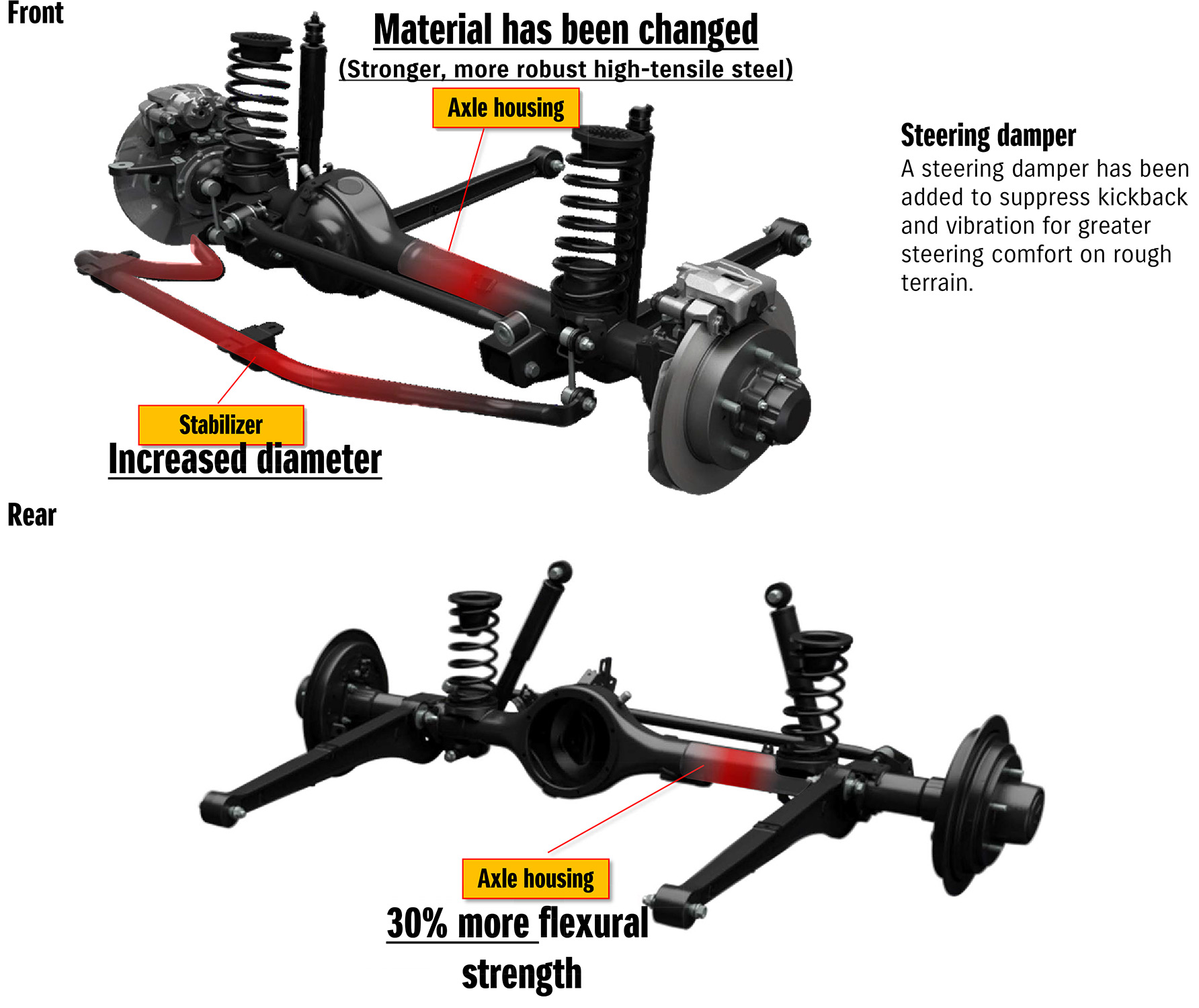
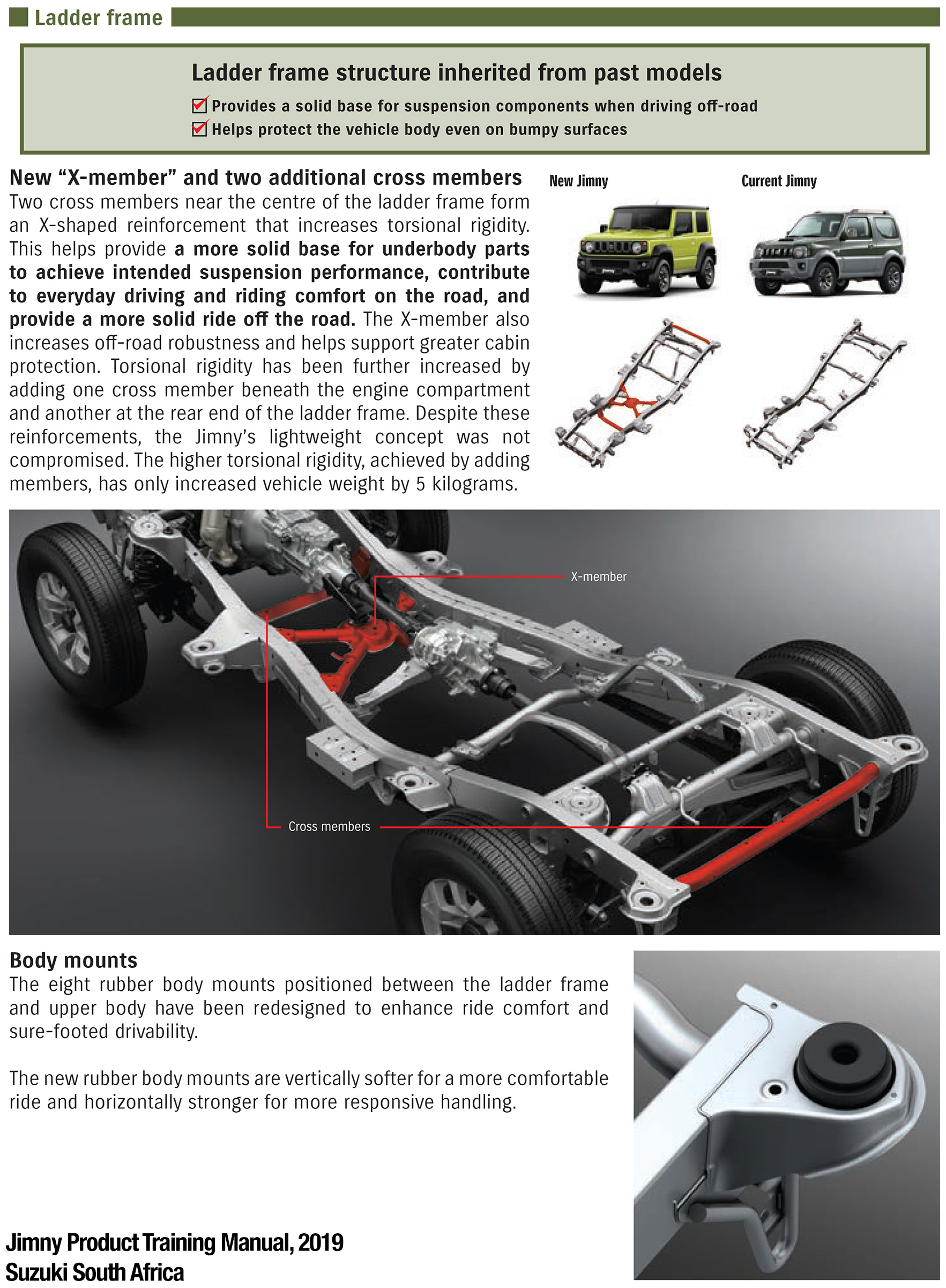
Another component of the revisions made for the gen4 Jimnys is in the strengthening of underneath: both axles are strengthened (and widened), and the chassis has additional crossmembers and revised body mounts as well.
Updated safety features
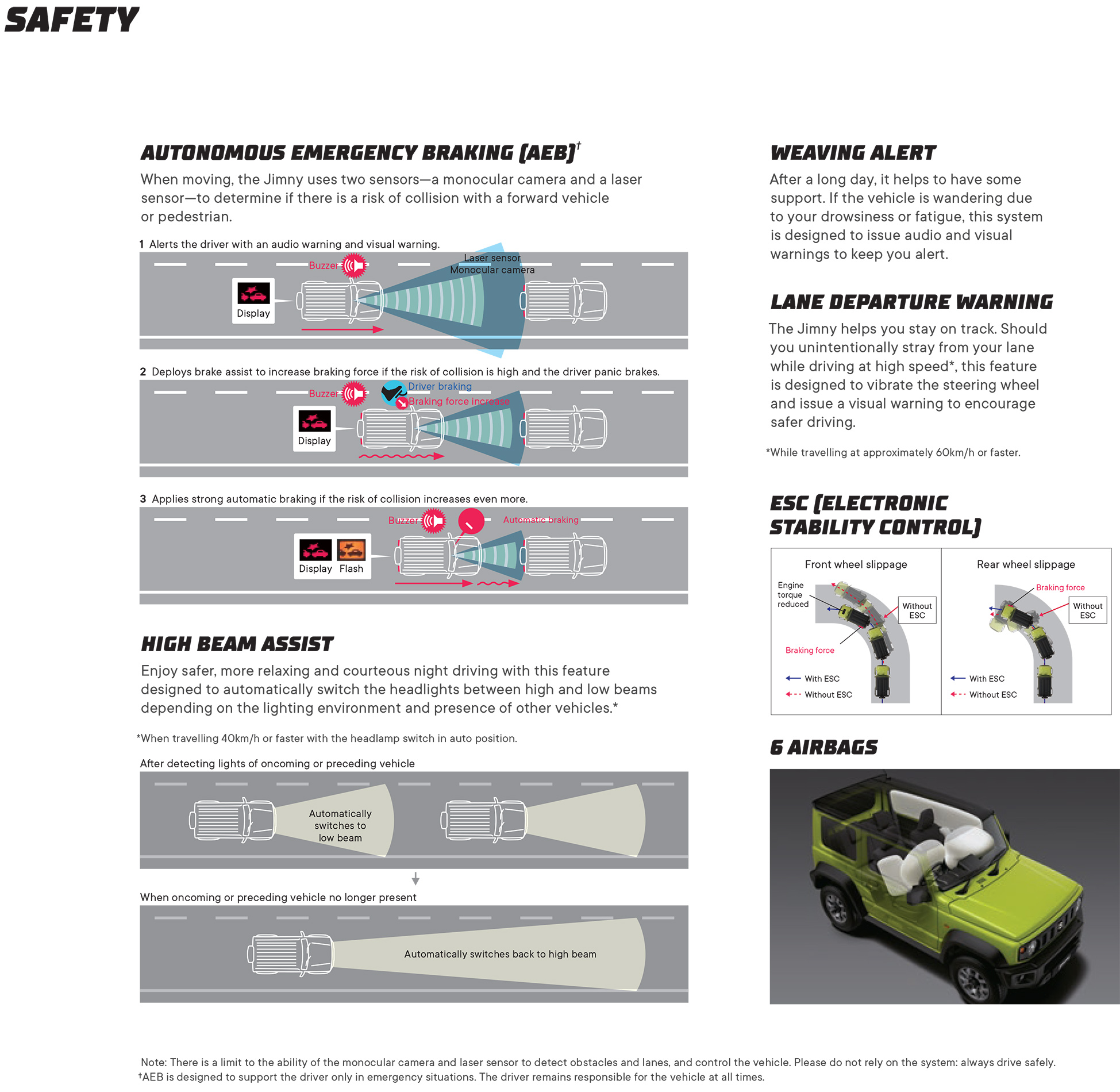
Although the generation 3 Jimny was the first to have any airbags at all, and introduced more advanced traction control later in its lifespan, the 4th generation Jimny was designed for the inclusion of a number of modern safety features. These features heavily in all advertising and press material relating to the car, e.g. from Suzuki Australia’s main original brochure we have all of the safety features brought to the fore.
Second-stage manufacturer GVM upgrades
Something I spotted when snooping around on the compliance database in late Sept 2020 was the addition of Ironman as a 2nd stage manufacturer, paving the way for pre-registration GVM upgrades that are all of Australia legal when changing state of registration later. I note the timing here as it wasn’t till after this snooping that the GVM upgrade ended up being reported on.
This is the first time a Jimny has had an official, pre-registration GVM upgrade in Australia. This upgrade, provided through Ironman, massively simplifies re-registering the car in a different state, although does come with a cost over the Ironman lift which I believe to have the same specifications. Sometimes paperwork is incredibly expensive.
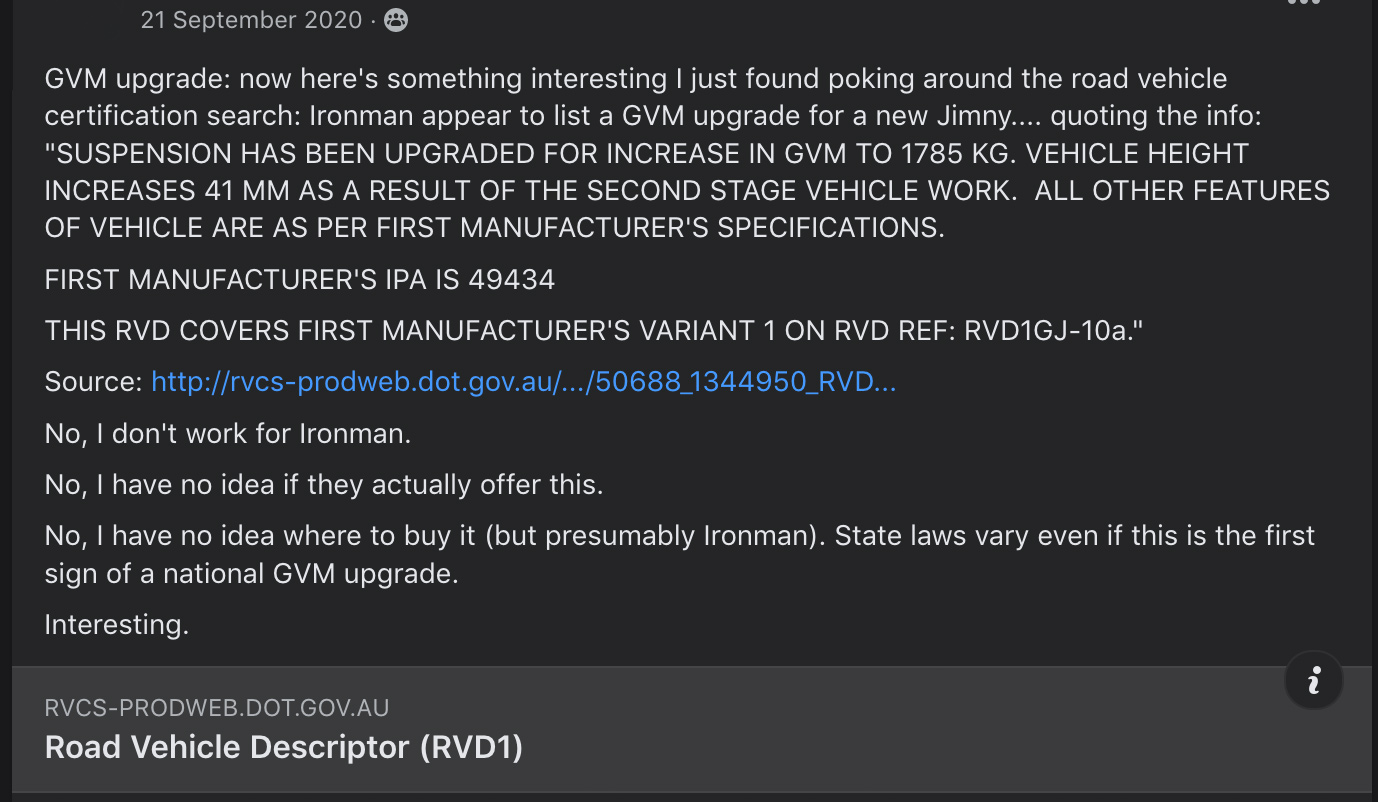
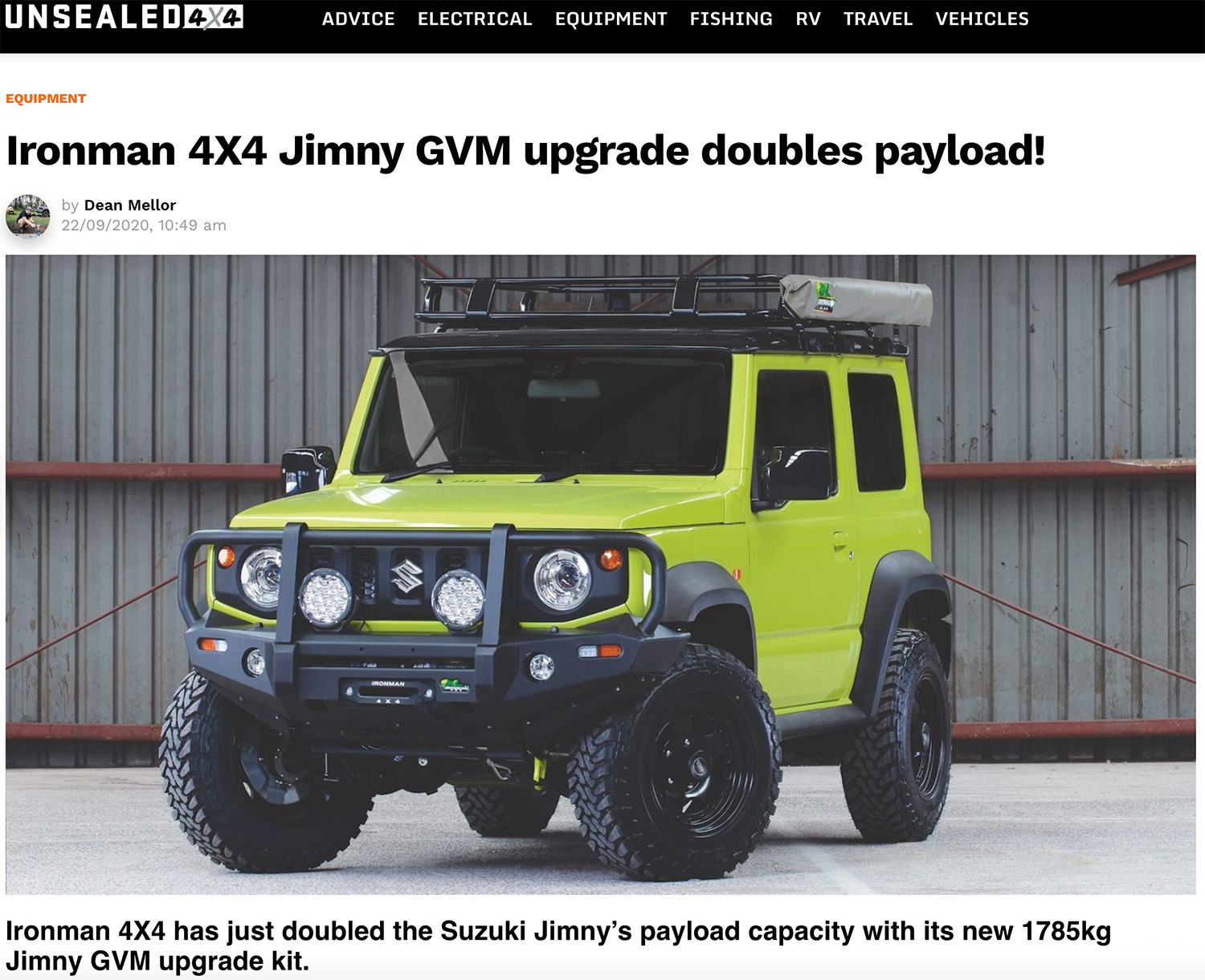
The Ironman press release for this ended up being dated 23 Sept 2020. Hilarious what you can find in databases sometimes!
Approval number for this upgrade is under compliance type approval VTA-050688.
Additonal SSM GVM upgrade(s)
In mid 2023, it was announced that Tough Dog have also gained national approval for a second-stage manufacturer GVM upgrade for the JB74. Their kit takes the GVM out to 1800 kg.
Approval number for this upgrade is VTA-061893.
Sales figures
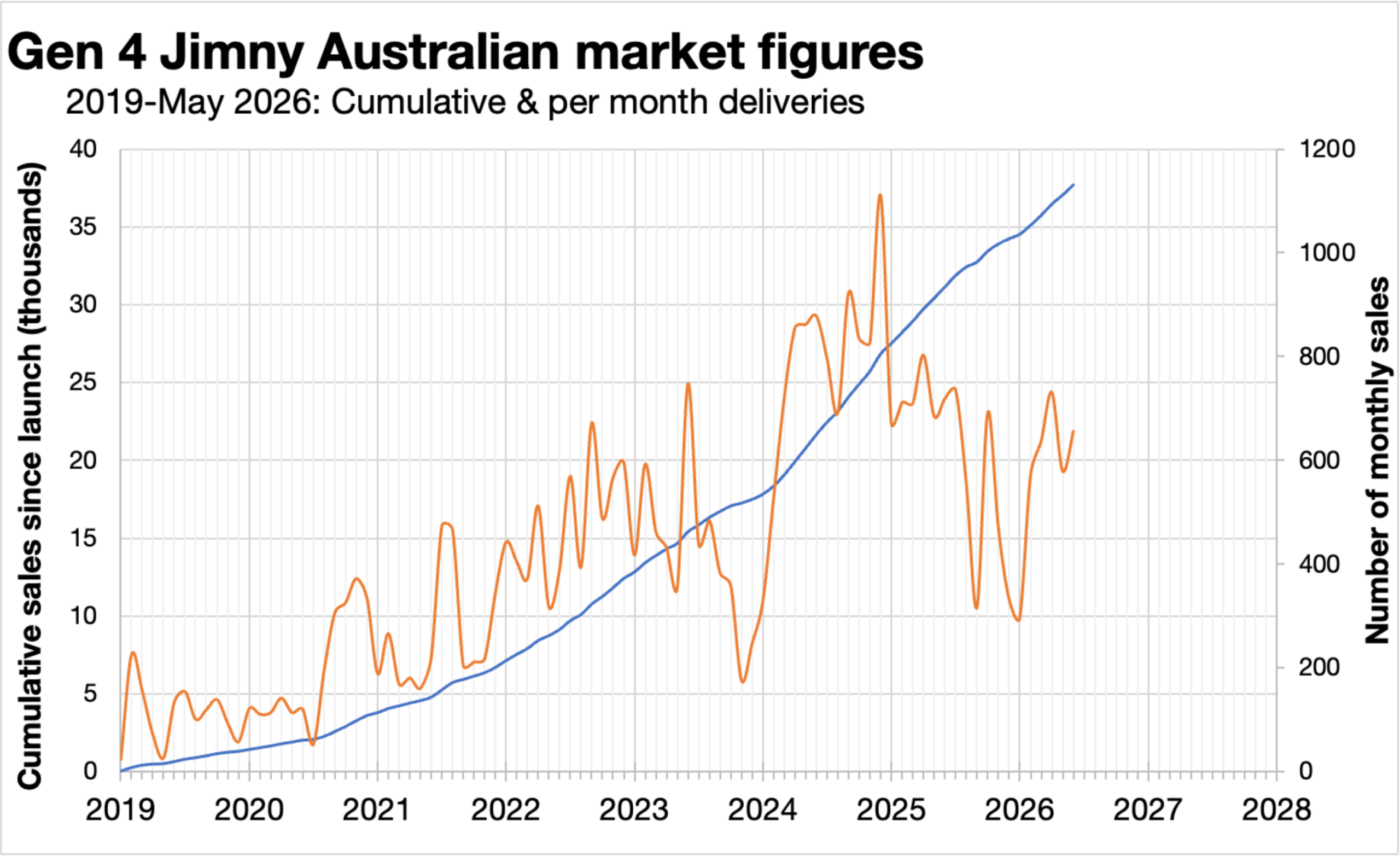
The 4th generation Jimny has proven to be highly successful on the sales front. By March 2023 it had already overtaken the sales of the 3rd generation Jimny; in the middle of 2026 it was closing in on 40,000 units sold. Considering the 3rd generation Jimny was for sale for 20 years in Australia, and the 4th generation overtook it in just a hair over 4, it certainly has proven to be a more successful model.
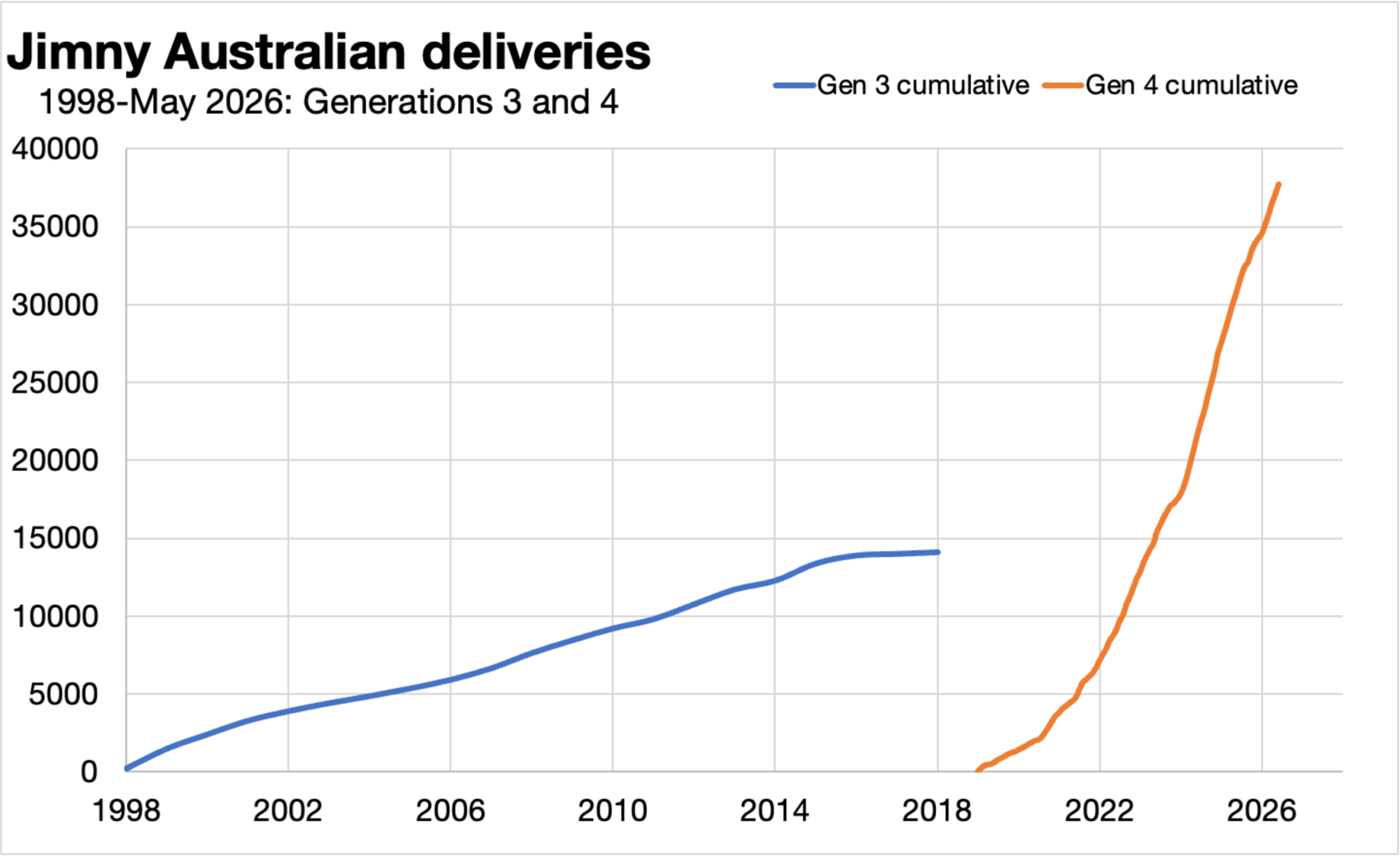
Because of how sales are reported in Australia, these numbers are based on month of delivery i.e. the effective ‘sale’ was made earlier with someone’s commitment to buy. Note that these numbers are combined 3 and 5 door sales from December 2023 onwards. Suzuki do not distinguish between the two models in sales figures reporting. Best estimates from checking VIN data and registered vehicle data indicates roughly a 50:50 split between the two.
This split of 50:50 between 3 and 5 doors in Australia is backed up by the sales data. Sales roughly doubled after the introduction of the 5 door, and they halved in the latter half of 2025 as supplies of the first generation 3 doors waned while awaiting the MY26 update for the 3 doors.
Here’s both the overall sales and the monthly sales:
| Year | Month | Sales | Year to date sales | Total sales |
|---|---|---|---|---|
| 2019 | January | 225 | 225 | 225 |
| 2019 | February | 155 | 380 | 380 |
| 2019 | March | 70 | 450 | 450 |
| 2019 | April | 26 | 476 | 476 |
| 2019 | May | 134 | 610 | 610 |
| 2019 | June | 154 | 764 | 764 |
| 2019 | July | 100 | 864 | 864 |
| 2019 | August | 119 | 983 | 983 |
| 2019 | September | 138 | 1121 | 1121 |
| 2019 | October | 92 | 1213 | 1213 |
| 2019 | November | 57 | 1270 | 1270 |
| 2019 | December | 121 | 1391 | 1391 |
| 2020 | January | 110 | 110 | 1501 |
| 2020 | February | 113 | 223 | 1614 |
| 2020 | March | 141 | 364 | 1755 |
| 2020 | April | 113 | 477 | 1868 |
| 2020 | May | 119 | 596 | 1987 |
| 2020 | June | 52 | 648 | 2039 |
| 2020 | July | 195 | 843 | 2234 |
| 2020 | August | 306 | 1149 | 2540 |
| 2020 | September | 325 | 1474 | 2865 |
| 2020 | October | 372 | 1846 | 3237 |
| 2020 | November | 334 | 2180 | 3571 |
| 2020 | December | 188 | 2368 | 3759 |
| 2021 | January | 266 | 266 | 4025 |
| 2021 | February | 168 | 434 | 4193 |
| 2021 | March | 180 | 614 | 4373 |
| 2021 | April | 160 | 774 | 4533 |
| 2021 | May | 219 | 993 | 4752 |
| 2021 | June | 474 | 1467 | 5226 |
| 2021 | July | 466 | 1933 | 5692 |
| 2021 | August | 203 | 2136 | 5895 |
| 2021 | September | 211 | 2347 | 6106 |
| 2021 | October | 217 | 2564 | 6323 |
| 2021 | November | 344 | 2908 | 6667 |
| 2021 | December | 442 | 3350 | 7109 |
| 2022 | January | 404 | 404 | 7513 |
| 2022 | February | 372 | 776 | 7885 |
| 2022 | March | 512 | 1288 | 8397 |
| 2022 | April | 317 | 1605 | 8714 |
| 2022 | May | 390 | 1995 | 9104 |
| 2022 | June | 569 | 2564 | 9673 |
| 2022 | July | 394 | 2958 | 10067 |
| 2022 | August | 672 | 3630 | 10739 |
| 2022 | September | 488 | 4118 | 11227 |
| 2022 | October | 567 | 4685 | 11794 |
| 2022 | November | 595 | 5280 | 12389 |
| 2022 | December | 417 | 5697 | 12806 |
| 2023 | January | 593 | 593 | 13399 |
| 2023 | February | 462 | 1055 | 13861 |
| 2023 | March | 431 | 1486 | 14292 |
| 2023 | April | 355 | 1841 | 14647 |
| 2023 | May | 748 | 2589 | 15395 |
| 2023 | June | 438 | 3027 | 15833 |
| 2023 | July | 484 | 3511 | 16317 |
| 2023 | August | 382 | 3893 | 16699 |
| 2023 | September | 358 | 4251 | 17057 |
| 2023 | October | 175 | 4426 | 17232 |
| 2023 | November | 247 | 4673 | 17479 |
| 2023 | December | 329 | 5002 | 17808 |
| 2024 | January | 527 | 527 | 18335 |
| 2024 | February | 722 | 1249 | 19057 |
| 2024 | March | 856 | 2105 | 19913 |
| 2024 | April | 862 | 2967 | 20775 |
| 2024 | May | 878 | 3845 | 21653 |
| 2024 | June | 795 | 4640 | 22448 |
| 2024 | July | 691 | 5331 | 23139 |
| 2024 | August | 923 | 6254 | 24062 |
| 2024 | September | 834 | 7088 | 24896 |
| 2024 | October | 827 | 7915 | 25723 |
| 2024 | November | 1111 | 9026 | 26834 |
| 2024 | December | 671 | 9697 | 27505 |
| 2025 | January | 712 | 712 | 28217 |
| 2025 | February | 710 | 1422 | 28927 |
| 2025 | March | 803 | 2225 | 29730 |
| 2025 | April | 685 | 2910 | 30415 |
| 2025 | May | 719 | 3629 | 31134 |
| 2025 | June | 736 | 4365 | 31870 |
| 2025 | July | 556 | 4921 | 32426 |
| 2025 | August | 316 | 5237 | 32742 |
| 2025 | September | 692 | 5929 | 33434 |
| 2025 | October | 470 | 6399 | 33904 |
| 2025 | November | 332 | 6731 | 34236 |
| 2025 | December | 296 | 7027 | 34532 |
| 2026 | January | 570 | 570 | 35102 |
| 2026 | February | 637 | 1207 | 35739 |
| 2026 | March | 731 | 1938 | 36470 |
| 2026 | April | 579 | 2517 | 37049 |
| 2026 | May | 656 | 3173 | 37705 |
| 2026 | June | 689 | 3862 | 38394 |
| 2026 | July | 575 | 4457 | 38989 |
| 2026 | August | 514 | 4971 | 39503 |
The strength of the 4th generation sales numbers has been such that supply has been stretched even with a rapid increase of supply into Australia and also price rises. Indeed, the popularity has proven to be so overwhelming at times that, in the face of unprecedented demand that automatic sales were halted late January 2023 by the Australian distributor.
The Jimny has increasingly been the major player in Suzuki’s lineup in Australia, accounting for an ever increasing % of Suzuki sales overall.
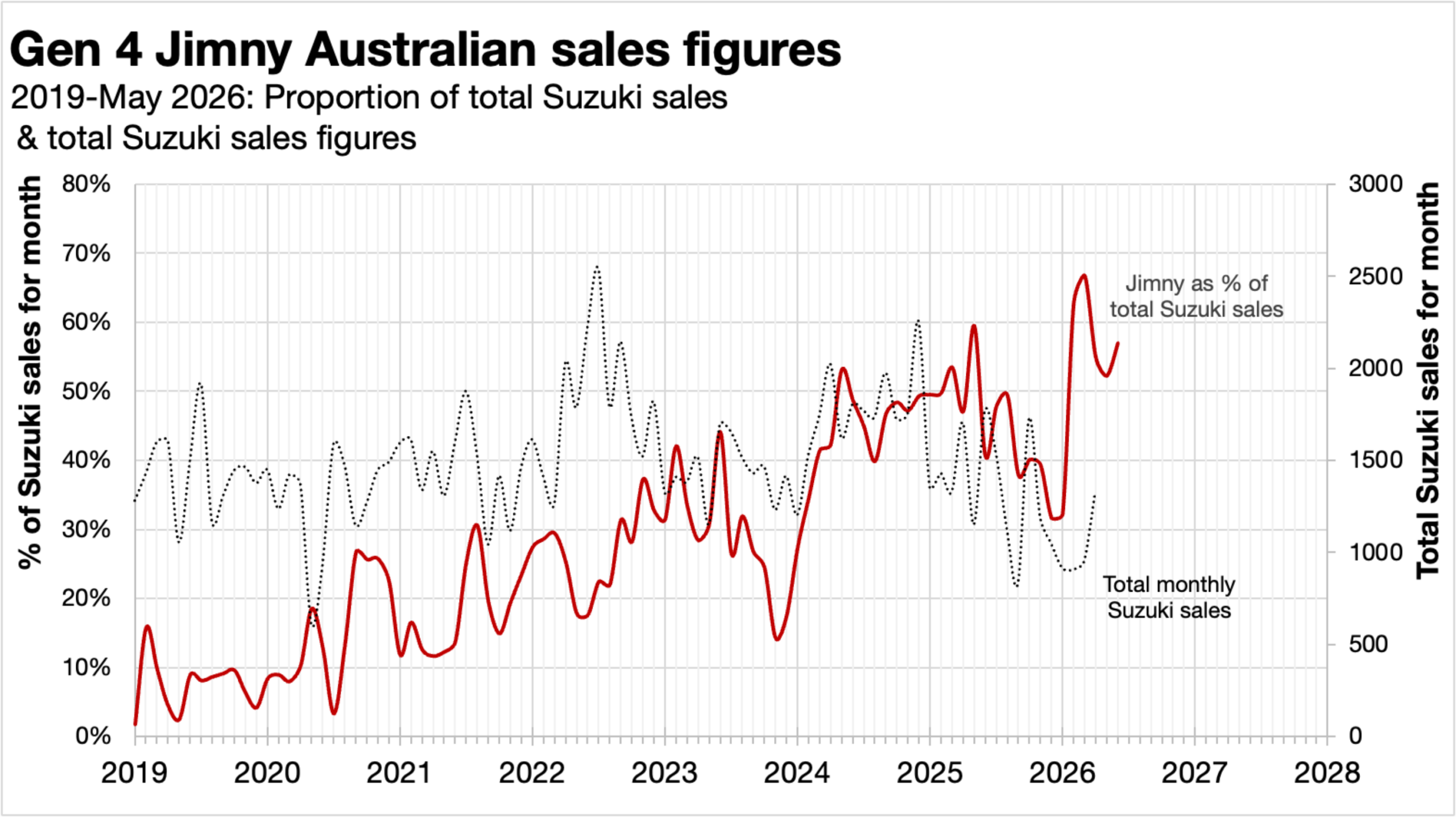
Essentially, Suzuki total sales per month have dropped from ~1400 units per month to around 1000 cars a month, and Jimnys have gone from being 10-25% of this to around half of all Suzukis sold per month.
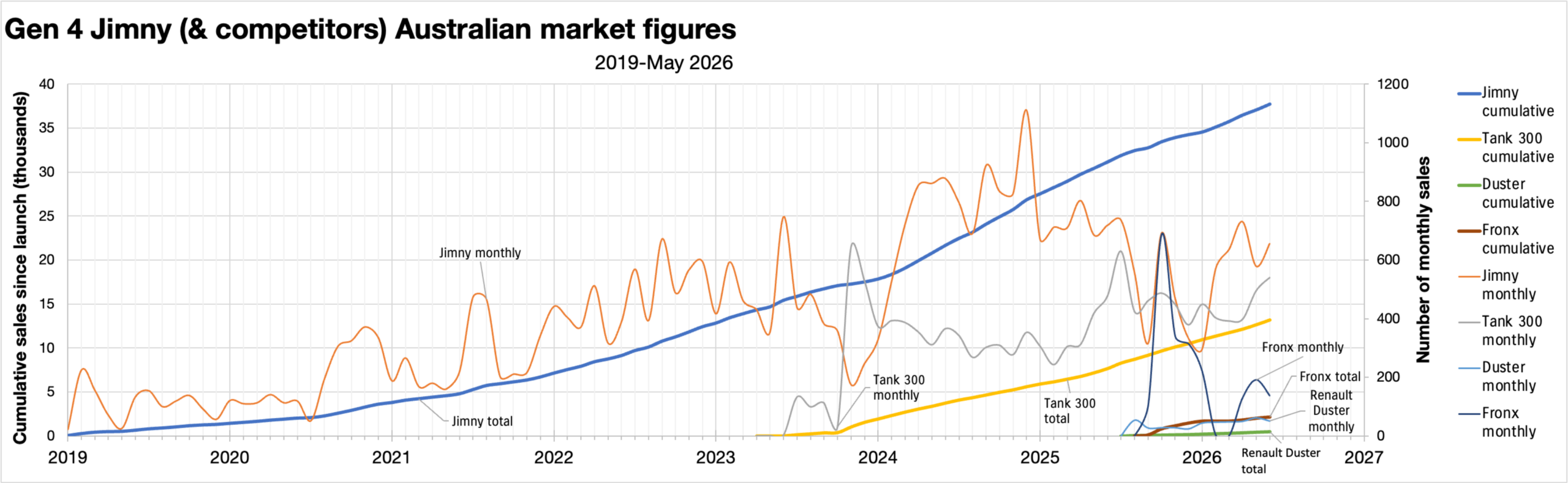
There’s been a few competitors – often not really as they represent different segments of the markets – that the press have tried to pitch as Jimny competitors. I’ve kept tabs on a couple of them for a point of historic comparison as to where the Jimny sat in the market.
| JB/JC74 Jimny | GWM Tank 300 | Renault Duster (all models) | Suzuki Fronx | |
|---|---|---|---|---|
| On sale since | January 2019 | June 2023 | June 2025 | July 2025 |
| Total sales to July 2026 | 38 989 | 14 177 | 621 | 2 569 |
| Average sales per month since launch | 428 | 373 | 48 | 214 |
Inside Suzuki there are aims for some of the Fronx sales to offset Jimny sales; this gains them some extra breathing room under the NVES. Unfortunately, some hiccups in the Fronx rollout (not to mention the name) has not really seen this come true. Other than September 2025, the main launch month for the Fronx where it almost sold as many units as the Jimny, the Fronx has not outsold the Jimny any other month.
Often on discussion forums or with some journalists you will see the original launched cheapest GWM Tank 300 compared to the Jimny, ostensibly on offroad capability and ‘boxy styling’ plus being similar in price. These are very different cars in size and style. The Tank does certainly demonstrate offroad prowess but it certainly doesn’t hit the simple (but not simplistic) mark of the Jimny and its lack of reliance on technology. There are only a couple of months where the Tank 300 has outsold the Jimny, otherwise the Jimny has sold 20,000 cars in the ~3 years since the Tank went on sale compared to the Tank selling about 15,000 cars. Note this only includes the Tank 300, not the higher variants.
A final Jimny competitor pitched by journalists is the Renault Duster. Similar in size to the 5 door Jimny XL, and with some offroad prowess, 4wd Dusters are another potential option depending on the level of offroading that people see.
Jimny pricing
A lot of the time you’ll hear people talking about how the Jimny is overpriced and it should be a $25,000 car. Ignoring the reality of how expensive all cars are now, Jimny sales have effectively not been muted too much (to date) by price rises. To allow for a fair comparison I have had to adjust current driveaway pricing to equivalent to the launch RRP without dealer delivery and other onroad costs. These prices are also for the base colour of white, other colours command a premium over this.
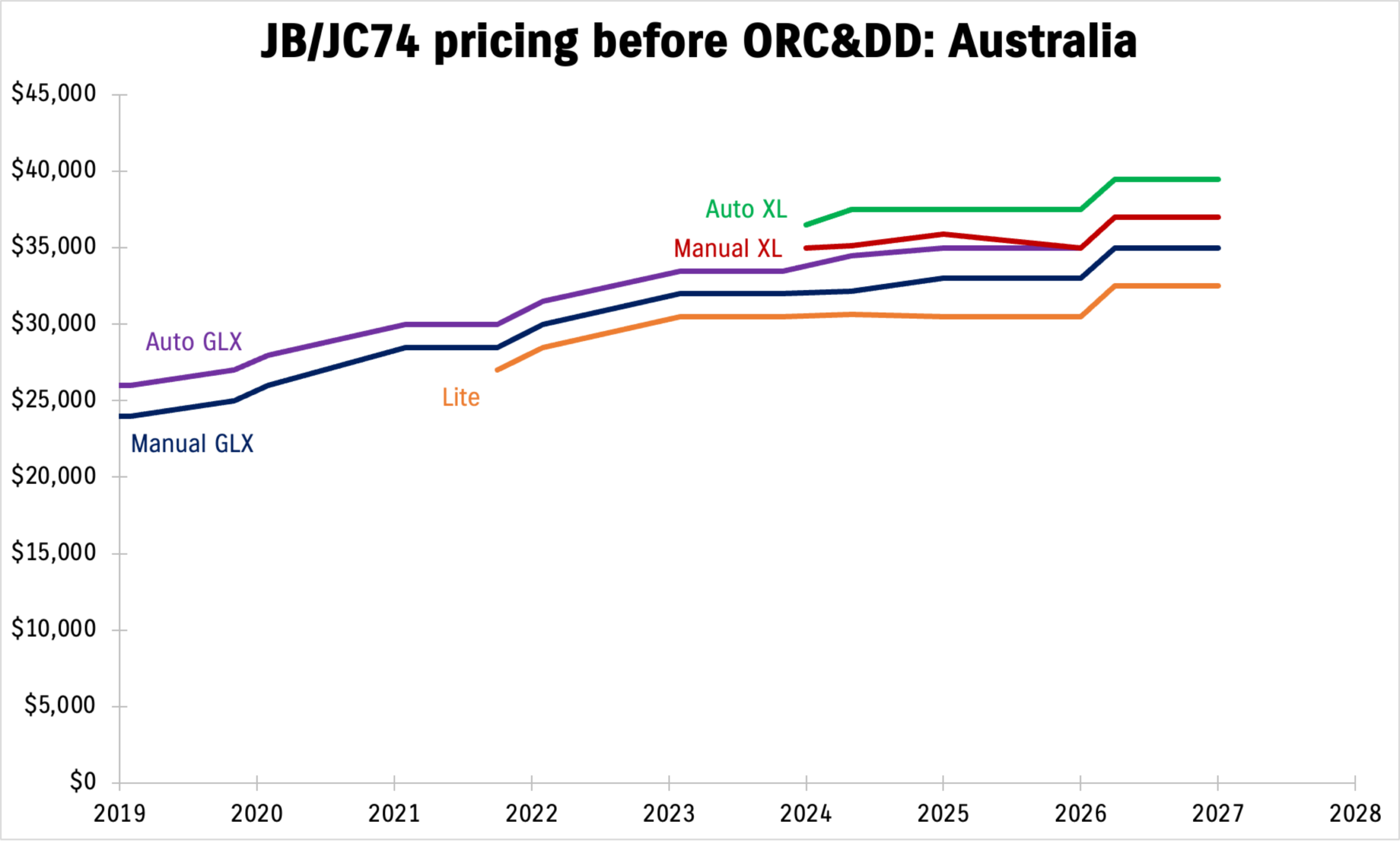
Adjusting for inflation to mid 2025 pricing, Jimnys have seen a less dramatic pricing in real terms, though effectively they’re $4,000 more expensive now than they were at launch once you adjust for inflation.
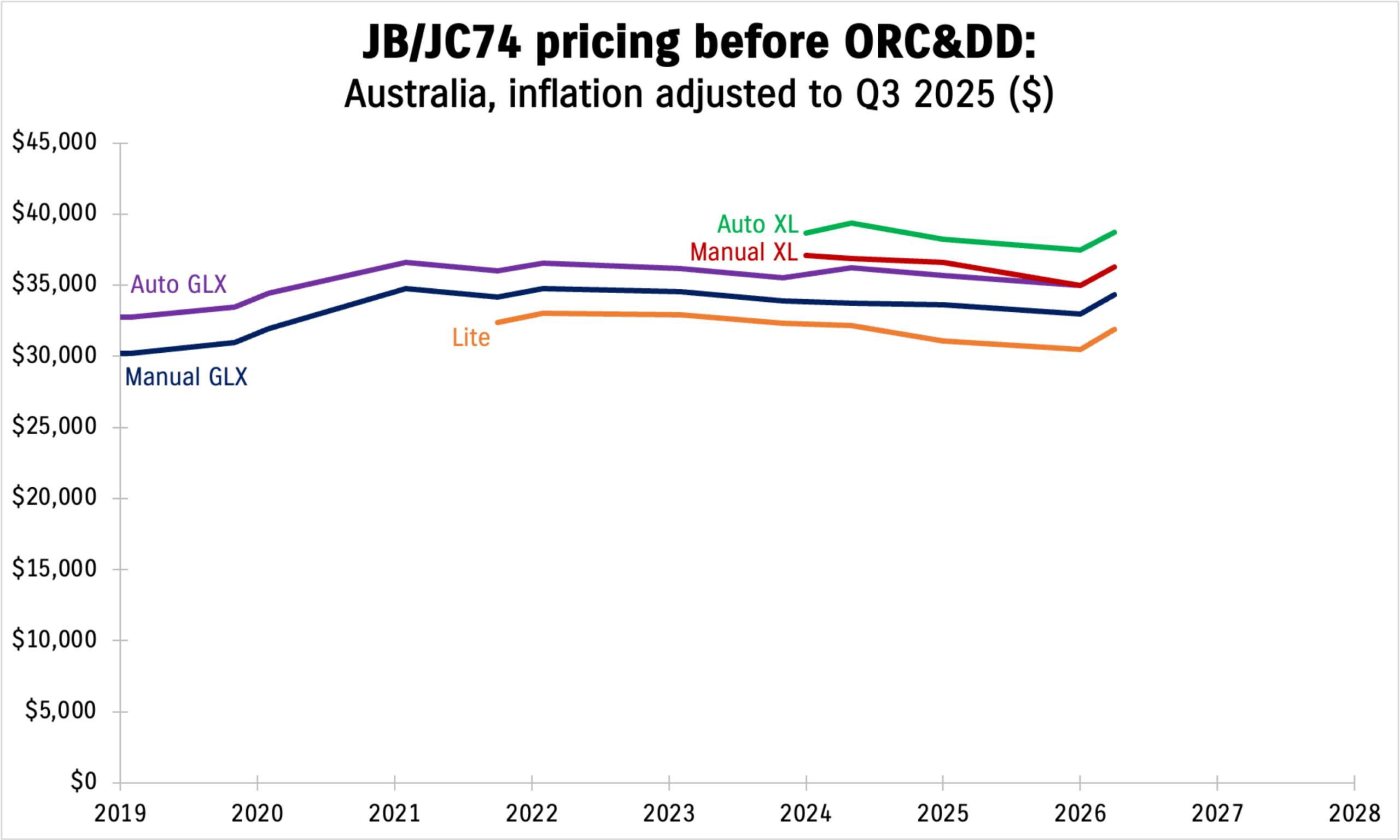
Despite the price rises, the Jimny remains almost the cheapest way to get 4wd in terms of new 4wd pricing. Once you account for excellent resale on used Jimnys, even today with more supply on the market, they represent a very low cost way to enter the hobby of going offroad.
LWB Generation 4
Ever since the popularity of the 4th generation Jimny became apparent, there were rumours of either higher powered or larger variants. Officially released at the start of 2023, and launched in Australia December 2023, the LWB variant is covered in its own writeup. It did not introduce more power or more seats, but a nearly 40 cm stretched wheelbase was the major change.
EV Generation 4 Jimny
Another persistent rumour has been the introduction of an electric Jimny out of Europe. This has been somewhat confirmed with a leaked slide from a presentation showing the upcoming lineup of vehicles.
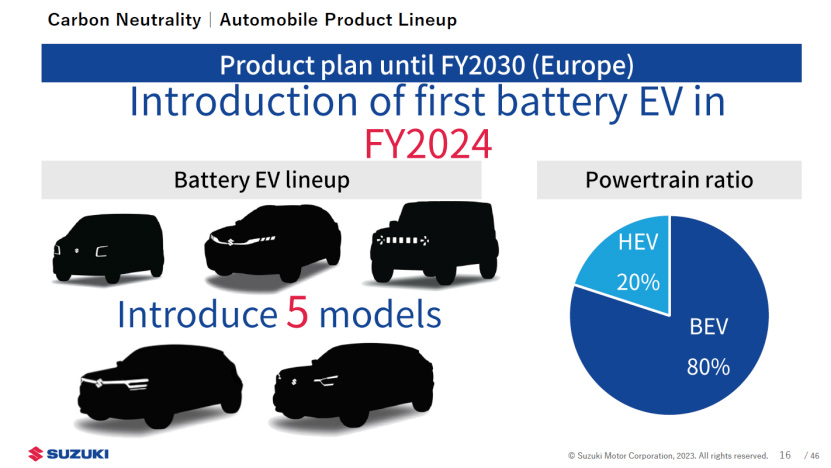
At this stage, very little else is known. Based on the timeline of the 5 door long Jimny, expect endless speculation and wild theories. If you want to make your own guesses, all of the articles speculating on this introduction are based off the Suzuki global strategy 2030 published January 2023.
Heritage edition: 2023
Introduced in 2023 in Australia, ostensibly as a special edition but practically to draw down on stocks of 3 door manuals, was the Heritage edition 3 door Jimny.

This package was $1500 more expensive than a manual 3 door Jimny, and was based on the GLX specification. To the GLX specification it added:
- Heritage build sticker, # out of 300
- External graphics package
- Red heritage mudflaps
- A limited edition Heritage luggage mat
- A Jimny Heritage drink bottle
Sales of the Heritage were surprisingly fast for what was essentially a sticker package. Some colours sold out within the day, and stocks were in under a week. They were available in 4 colours: white, medium grey, jungle green and the bluish-black pearl. I don’t have definitive numbers but I understand they were somewhat proportional to interest of the Jimny colours in general, i.e. a bit over 100 of the white, and far fewer than that of the black.
There are limited pictures of the Heritage package and interior shots. The only photo I can find of the luggage tray indicates it’s a bit like the Trufit 3D mats and has a Jimny rhino logo on the back drivers side corner.
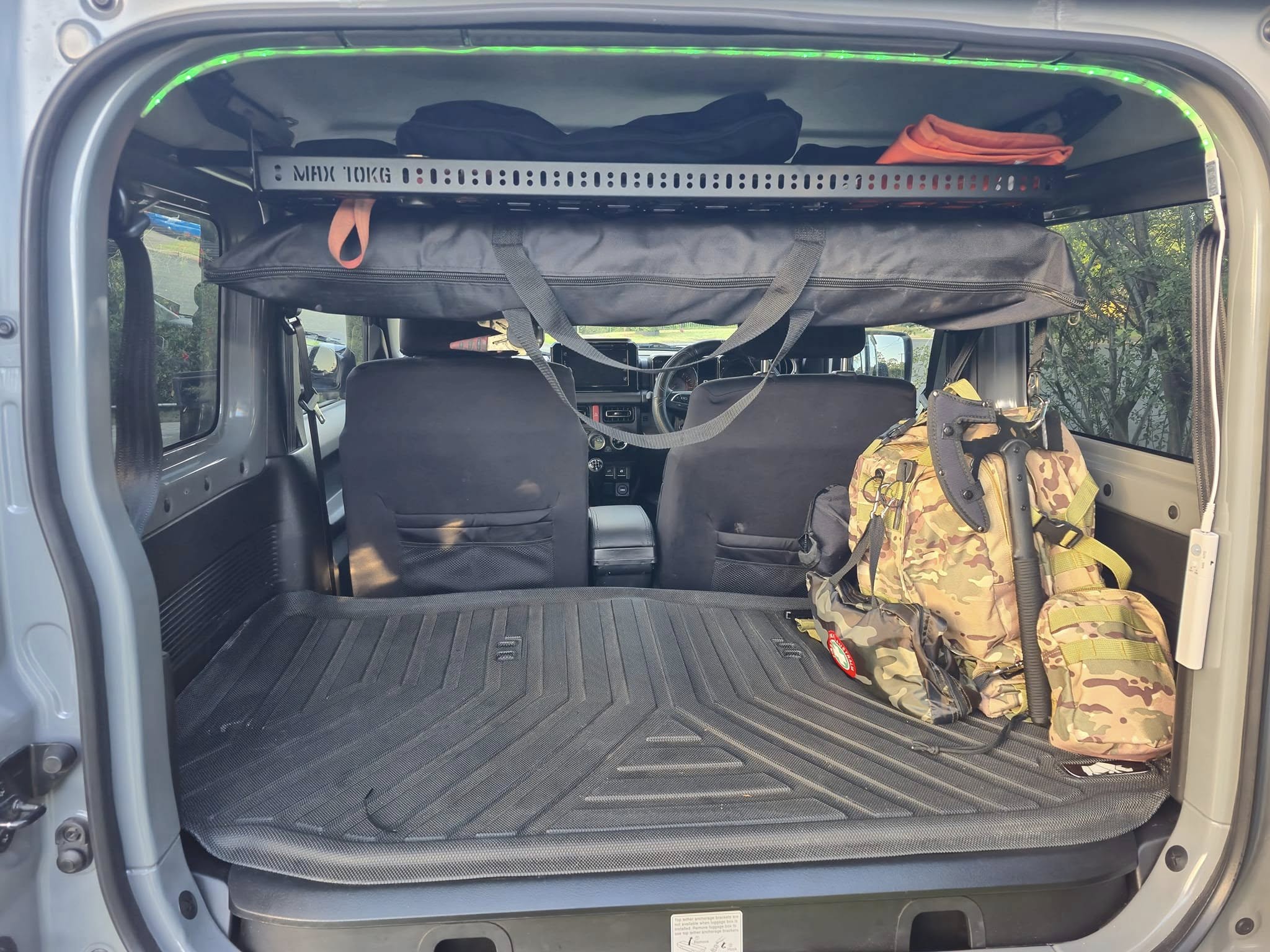
There is not a register of Heritages, though build 1/300 is VIN JSAGJB74V00201407, a medium grey heritage. Heritages are also not sequential VINs and the Heritage # is not sequential with VINs, e.g. heritage 229/300 is an early VIN than heritage #084. Heritages generally seem to be built December 2022 through to early February 2023, with compliance in late May or early June 2023 depending on delivery date.
The Heritage graphics have been duplicated by a number of places around the internet, meaning seeing Heritage graphics is no proof of Heritage provenance. At least one Heritage I know was also de-graphiced, and accident repairs are unlikely to be able to source official Heritage graphics so lack of Heritage graphics also doesn’t mean a model isn’t a Heritage.
The red mudflaps originally provided on Heritages turned pink, and were subject to an unofficial recall.
A run of 500 Heritage edition 5 door Jimnys was also introduced, though their sales were less successful.
MY 2026 changes
MY2026 3 door cars received a few changes, predominantly in response to additional safety requirements around autonomous emergency braking in many markets it is sold in.
Specifically in Australia, the introduction of ADR98/00 (which matches an EU regulation) was not quite met by the single camera system used in the MY19-25 3 door cars. 3 doors (and some other Suzuki models) which received Australian compliance before the end of February 2025 were elligible to be sold, but no more could be brought in beyond that date.
A stockpile of around 2000 cars was brought in just prior to this date, allowing a trickle of 3 door sales through 2025, but this was practically exhausted before the end of 2025. Meanwhile, in Japan, development was occurring to provide an update to the 3 doors to allow them to be sold in markets like Australia.
That update somewhat leaked in the latter half of 2025, and consisted of:
- A revised single camera unit for autonomous braking;
- Front radar sensor, and ultrasonic front and rear sensors, for increased pedestrian detection
- A different digital dashboard
Announced in late 2025 was the return of the 3 door to Australia, with the added features noted above but also a revision where even lites receive a basic infotainment system: lites get the 7″ Bosch unit from the original Australian specification 3 doors, and GLXs receive the 9″ unit also seen on 5 door Jimnys.
This future proofs the Jimny in two ways:
- The revised autonomous braking meets ADR98/01, due for introduction for existing cars in the next couple of years (5 doors only meet ADR98/00, not /01); and,
- Rear vision requirements through the use of a reversing camera is met by all models in the lineup, a requirement from November 2025 for new cars and existing cars from 2027.
The revisions do mean some differences for accessories. A revised towbar wiring harness for the 3 doors is expected in the middle of 2026, and many bullbars require modification to support the radar and ultrasonic sensor and are expected in late 2026.
It also means that the 3 door is future proofed for incoming safety requirements for at least the next few years in Australia, with better pedestrian detection built-in via the new sensors. It is unclear if these changes will immediately flow onto the 5 door Jimnys or they will only be introduced when required.
You can recognise MY2026 3 door Jimnys in a few ways:
- Build date on the RAV is from December 2025 onwards for Australian delivered cars; first VIN appears to be JSAGJB74V00228960, versus last VIN for MY19-25 cars in Australia is JSAGJB74V00223125
- The presence of the slightly differently shaped cutout in the front bumper for the radar
- The digital dashboard