
Steering pull or phantom ESP
This is the catchall for one of the common issues for both 3 and 5 door generation 4 Jimnys: either steering pull after a suspension lift or the car develops phantom ESP intervention when turning one direction much more than another. With 5 door Jimnys, and potentially MY2026 and beyond 3 door Jimnys, there might be tighter tolerance on the steering angle sensor giving you an adaptive cruise and autonomous braking warning error either sometimes or all of the time you drive the car.
After a lot of investigation and working through the problem, my own thought is that these are linked and often the issue comes down to alignment shops overthinking the Jimny’s system and/or not thinking about what’s involved after a suspension lift.
Sections
- Symptoms
- My investigations
- Understanding the issue
- Myths
- Alignment is necessary after a suspension lift
- Resetting the steering angle sensor is a necessary step
- Why I think alignment shops get it wrong
- What should you do after a suspension lift?
- Myths
- How to fix it
- Check steering centre lock to lock
- Check steering centre on the steering box
- Physical alignment: toe
- Physical alignment: draglink to set physical steering centre
- Check steering angle sensor setting at neutral steering
- Calibrate steering angle sensor and/or ESP sensors at rest
- Go for a drive and tweak
Symptoms
There are a few symptoms which, at first, might not seem related.
The first symptom is the steering wheel being pulled or pushed over to a particular angle that isn’t straight, potentially the car turning as part of this. This is not the steering wheel passively sitting to one side at the straight ahead which is when you just haven’t adjusted the draglink after a suspension lift, but it’s the car actively pushing the wheel over with the power steering to what the car thinks is centre.
The second symptom is much more insidious and can be worrying to people: traction control intervention mid corner when it isn’t needed. This is typically something you see turning in one direction over other, i.e. maybe it does it more commonly turning left instead of right, though sometimes it can happen turning in another direction.
If it happens very consistently in both directions, or it happens when the car gets unsettled by bumps but steering in either direction, then that’s a separate issue around the car overly reacting and unsettling the car: this article will be of a lot less help for you for this type of intervention.
My investigations
0. The steering angle sensor is, indeed, self learning and has a tolerance.
Putting this as point zero as it is that fundamental to the way the whole system works.
The steering angle sensor is self learning: when the car sees both rear wheels going the same speed for a long time, it knows the car is pointing straight. There is a steering angle offset parameter in the ESP system, and it is this which accounts for sensor drift over time.
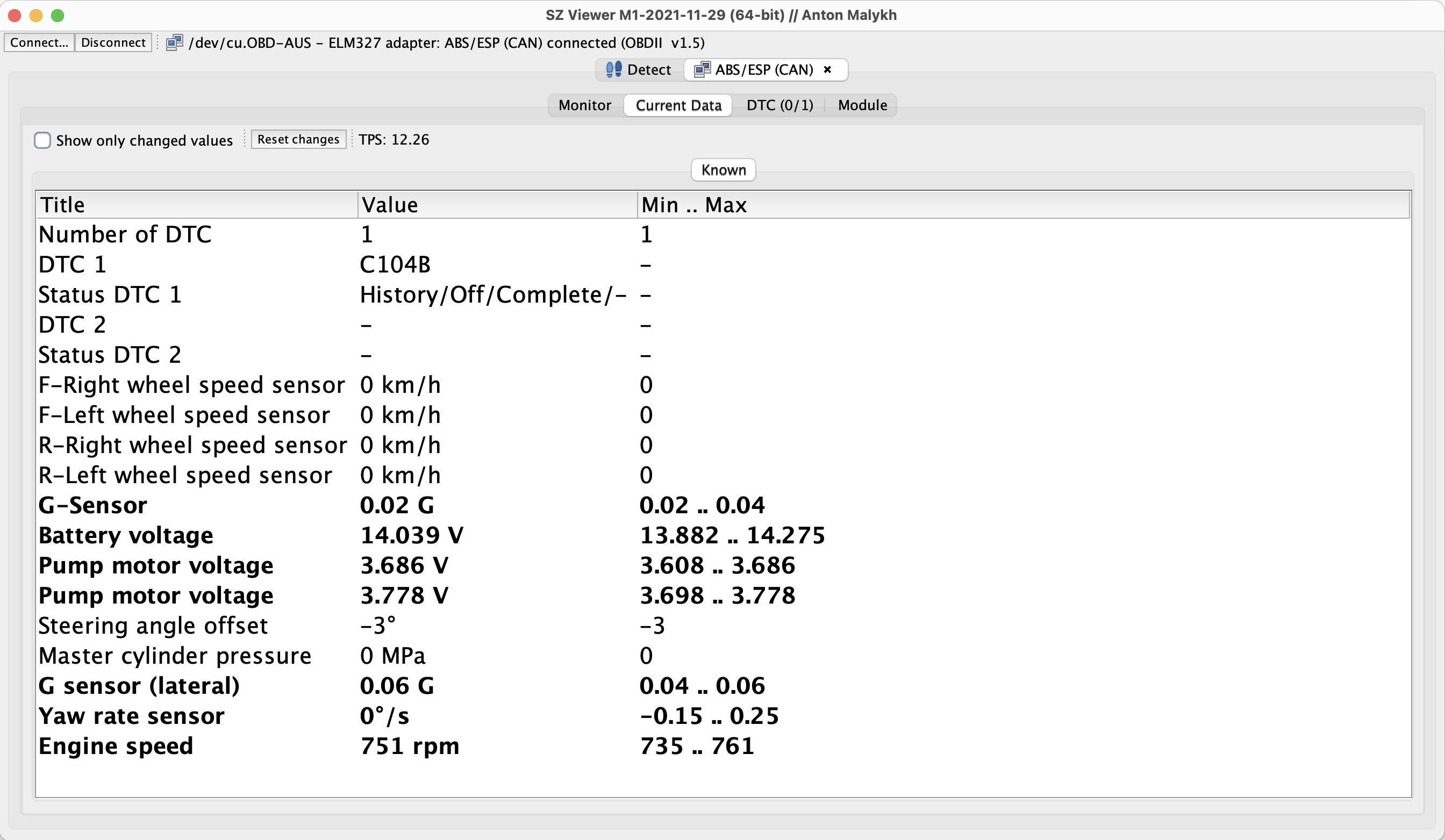
If you scan the car repeatedly over time with a scantool that can read the ABS/ESP module’s live data, you might notice this angle slightly changing. It slightly changes because it’s continually updating: the steering angle will change slightly with the car more loaded (same rationale as the steering wheel going to one side after a lift), and also the sensor will drift over time. This is all super normal, and it’s designed to work out, on average, where the steering wheel is situated with respect to the car driving straight ahead as measured by what the rear wheels are doing.
The steering angle centre learning procedure does seem to take some time to trigger after a calibration. I haven’t measured it, but it seems a lot ‘stickier’ around what the centre position has been than if you are letting the car gradually self learn the correct position. If you drive around for thousands of km after a lift with the steering wheel off centre it will learn this position pretty quickly and be ok, and even adjusting the drag link and re-centering the steering wheel physically won’t result in pulling.
If the steering angle sensor centre position is reset, however, either by physically moving the steering wheel/steering column or by resetting it/recalibrating the ESP sensors then it seems to stick to that for some time (like, at least hundreds and hundreds of km if not thousands). This is probably the number one reason why people think it’s necessary, but that’s only because you’re undoing an incorrect setting in the first place that the car (presently) hasn’t done enough km to allow it to re-learn centre.
This self learning for the steering angle sensor does have a tolerance. If the car sees you going outside the tolerance then it will raise a steering angle mismatch and disable some aspects of the autonomous braking and ABS/ESP systems; in an automatic 5 door Jimny or a MY2026+ 3 door it will also disable adaptive cruise control and give you an error on that.
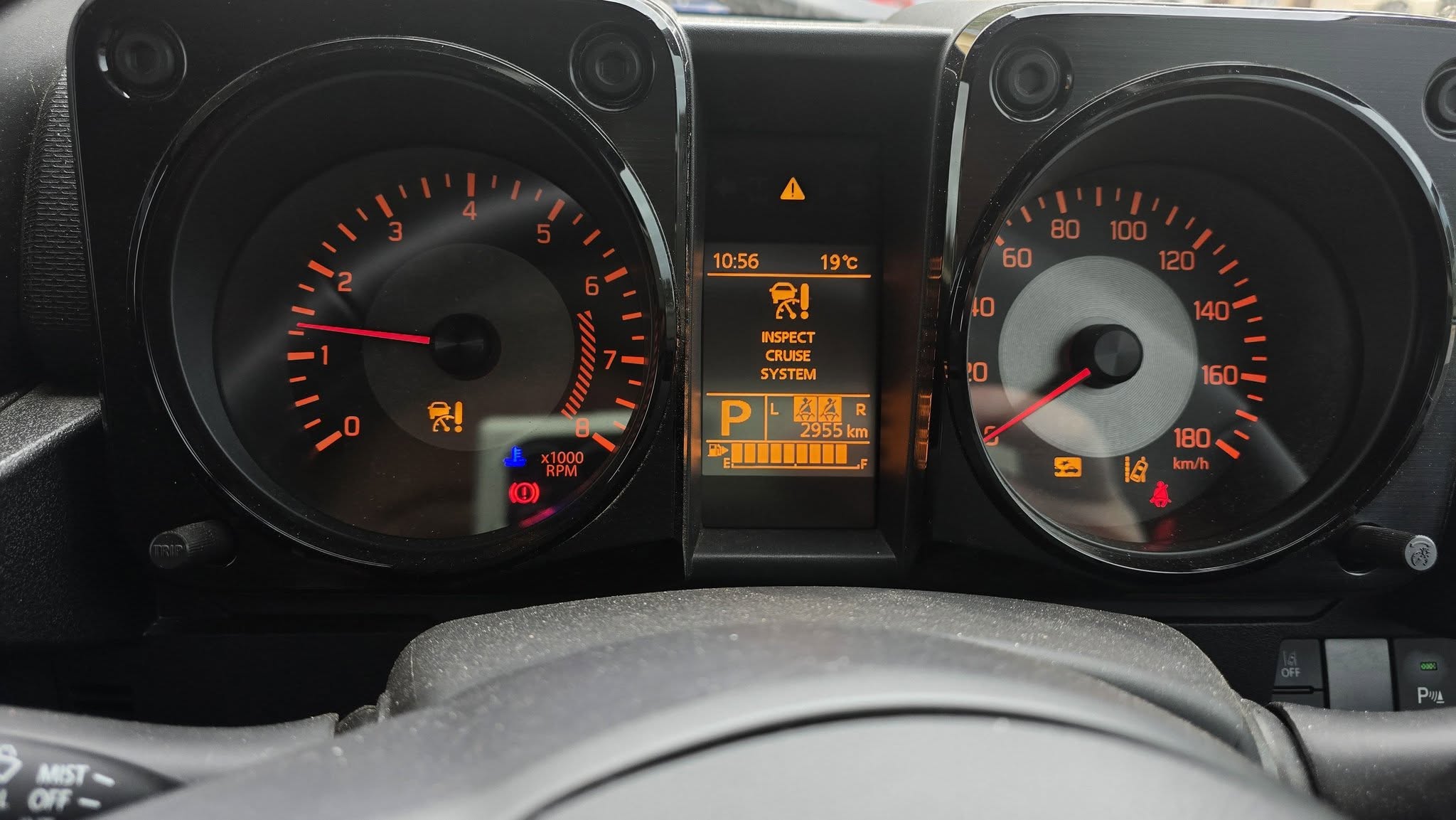
This tolerance is seemingly lower in those vehicles, too. You get a lot more 5 door drivers asking about an issue with the adaptive cruise control which relates to the car having an incorrect steering angle sensor default position, which means the tolerance is more easily exceeded.
The solution to that issue is also probably re-verifying the physical alignment and properly resetting the steering angle sensor to be centred and straight ahead with respect to steering play, as discussed in this article.
1. Not doing a steering angle sensor reset is the way to go when you install a lift or do an alignment unless it becomes necessary
You will always get a bunch of people saying the steering angle sensor reset is necessary, especially after a lift. In all of the suspension lifts I’ve installed for people it has not been assuming one just sensibly adjusts the draglink. An alignment is also not necessary since you don’t touch the toe setting when putting in a suspension lift.
If you get the alignment between straight ahead and steering wheel straight ahead, and the steering angle sensor was correctly calibrated at the factory, then the car will track straight ahead just as well as it did prior to the lift.
One minor exception to this is if you lack sufficient caster for the car to track nicely: the car will seemingly pull because insufficient caster means the car just follows whatever direction it previously was pointed in. This doesn’t mean you need a huge caster change, and indeed proper steering pulling is not fixed by caster correction, but it is a consideration after a lift if you don’t have caster correction and you think you’re experiencing steering pulling. Sort the caster out, sort out the steering wheel straight ahead in terms of physical alignment, and only then if that doesn’t resolve things then you consider playing with the magic pixies of the computational side of the steering system.
A steering angle sensor reset is needed when an alignment shop gets the car confused, however. Consider it a last resort once you have troubleshot everything else, rather than a fix-all.
2. Almost everyone (bar one person out of hundreds!) who experiences this have had professional wheel alignments done, usually after a suspension lift
Other than one person, who I think overly adjusted the draglink and managed to get the car confused, everyone who experiences this issue of steering pulling has had professionally done alignments. People who DIY a lift and just do the physical change to the draglink do not experience these symptoms.
Why is that? I think alignment shops simultaneously underthink and overthink the Jimny’s alignment. I say underthink because you need to do stuff in a precise order to not get the physical alignment side of straight ahead, toe and steering wheel centre a bit wonky, and then they do what they do on any modern car with electrics and reset steering angle sensor they can on their generic scantool. I also say overthink because places are quick to jump on the electrical/computational side when that’s just a little additional thing and, if you do it right, doesn’t need to be touched.
In addition, it’s possible alignment shops get the car confused about what straight ahead is when setting up the car on an alignment rack. Most alignment shops will slightly raise the rear axles to spin the wheels to average out any wheel imperfections to use them as a guide for what ‘straight ahead’ with reference to the chassis is. Without a bent rear diff this is perfectly valid and a good way to do it. The issue is that an open differential means if you turn one wheel forwards to spin it, the other wheel turns backwards at the same rate. The car cannot differentiate between these two and will see them as the car driving at the same speed. If the ignition is on, maybe the car self-learns the incorrect centre because the drag link hasn’t yet been adjusted, and then when that is adjusted the ‘new centre’ physically is mismatched to the new centre electrically.
I think this is why the South African video of ‘push it over the opposite angle to how much it is steering and then re-learn the steering angle sensor’ worked for them: they’re undoing whatever the alignment shop did to learn a centre that is not in relation to the proper physical steering wheel centre position.
This is also not endorsing that method, you should properly verify physical centre of the steering system and get that perfect, and then just reset the steering angle sensor at that correct centre position and all will be well again.
3. It is not solved by caster correction or adjustable panhard rods
Some degree of (physical) pulling of steering after a lift is resolved by caster correction. Insufficient caster, as I mentioned above, will make the car follow whatever was the last direction that you steered it in. It will also lack self centering, though the power steering will self centre at low speeds if it is a big steering input so it’s really only apparent just off centre in a generation 4 Jimny.
However, many people bleat that caster correction is the only correction needed. It isn’t. If your car is confused after an alignment shop has fiddled with it, no amount of caster will make it overcome the physical steering trying to centre it.
My experiments have also unearthed another aspect: overly correcting the caster can also add to phantom ESP situations, though usually it’ll be manifested in both directions. Additional caster unloads the inside rear wheel and adds load to the outside rear wheel (a phenomena known as caster jacking). This produces oversteer, and in a Jimny you already get roll-induced oversteer in cornering. The car will detect this oversteer and intervene earlier than you might think, either because you are starting to get inside wheel spin from the open diff & limited load on the inside rear wheel, or because of the oversteer changing the relationship between steering angle and detected yaw.
This is only apparent at high angles of caster (say 5º or more), e.g. using 4″ corrected arms on a 40mm lift, but, since cars can vary a lot with caster from the factory adding caster correction when you don’t need it for a small lift might actually make phantom ESP worse. However, this will be phantom ESP going both directions rather than more apparent in one direction, which is the symptom of phantom ESP induced by the sensed steering centre position being slightly wrong from incorrect calibration.
It is also not solved by adjustable panhard rods, despite some people insisting they are needed. You can have the car with quite off center axles and it will not pull any differently to if the axles are perfectly centered (which is all adjustable panhard rods do). You also don’t need a fancy alignment place to align your car after you put in adjustable panhard rods: just use the wheels inside lips to measure to the chassis to work out how off centre the axles are and adjust accordingly.
4. You can reset it with cheap bidirectional scantools but the calibration is not where you think it is
I’ve been experimenting for a while with various scantools to work out how a suitably informed DIYer can reset the steering angle sensor at home to try to rectify where an alignment shop has ended up getting it calibrated wrong.
Many scantools do not seem to reset it correctly. Plenty that say they can do Suzuki steering angle sensors do not seem to do it correctly with the Jimny. I think this is because they are trying to do it through the power steering module, but in fact the correct method with an aftermarket scantool seems to be doing it as part of the ESP sensor calibration mode & it is only done as part of the full ESP sensor calibration. Plenty of scantools allow you to see a steering angle sensor reset in the power steering module (and sometimes the ABS/ESP module), and some even say they work, but they do not. Only recalibrating all ESP sensors actually achieves a reset of the steering angle sensor.
As of March 2026, I have found the Foxwell NT710 bidirectional scantool with the Suzuki software they provide able to properly reset the steering angle sensor. Likely other options will work, though for the AU$250 I paid for it (with one free licence, which I used for the Suzuki software) it isn’t terrible value. I’m sure others they sell, and other similar type of aftermarket bidirectional scantools can do it, but it isn’t guaranteed.
5. You have to be awfully careful with how you calibrate the steering angle sensor
Because of the previously mentioned issue around how ‘sticky’ the steering angle calibration appears to be, if you have the steering wheel off center with the calibration procedure then it will learn the wrong position. A classic one here is not having the steering perfectly straight AND the steering wheel centered with respect to the steering play. This’ll learn an incorrect position which is hard up against one side of the ‘play’ of the steering, resulting in the car thinking you’re steering more commonly one way than another, which will result in the car detecting differences in yaw rate vs. steering angle between left and right, hence you either get pulling or you get traction control intervention.
If an alignment shop is not careful to center the wheel with respect to steering play AND have the steering physically centered in terms of the steering box, then I can easily see this being a huge issue. It also would be a massive explainer as to why this is an issue with professional alignment shops and not people doing it at home. If they didn’t calibrate the steering angle sensor it wouldn’t be an issue, which is why I say people should stop thinking of this as a necessary step, as it’s more possible to get the car confused when you do it.
Just adjust the draglink. The steering angle zero will follow what the wheel does if you don’t move the wheel in relation to the steering column or steering box.
6. What used to work on other Jimnys is not necessarily what you do with a generation 4 Jimny.
The final thing you see are people doing what they used to do in previous Jimnys or small Suzuki 4wds, not all of which came with adjustable draglinks from the factory. With those cars then the easiest way to get the steering centered sufficiently to drive it after a lift was just to pop the steering column or wheel off and rotate it one spline. You end up with slightly more steering one way than another way as steering column center no longer equals steering box center, but, it is the simplest cure instead of replacing the draglink with an adjustable one or a longer one that suits the lift.
If you do this with a generation 4 Jimny, despite what some people on forums say, the car will end up out of spec in terms of the steering angle sensor vs. what is straight ahead. The steering angle sensor will see a shift, but the car physically will not have had a change in terms of what straight ahead is.
The correct thing to do is adjust the draglink, but sometimes people for whatever reason think it’s easier to pop off the column u-joint at the steering box and move it over one spline instead of pulling out a couple of 24 mm spanners.
Understanding the issue
Physical steering centre. vs software viewed ‘centre’
With no electrics in play, the steering in the Jimny is incredibly simple. The steering wheel, through the steering column, connects down to a steering box.
That steering box has an arm on it, which is what steers the car when the steering wheel is turned.
The draglink connects the steering box to the passengers side wheel, and this is what transmits steering down to the front wheels.
The passengers side wheel is connected to the drivers side wheel by the toe link, which is what sets the toe (relative position) between the two front wheels.
When we talk about the steering centre physically, I mean the centre that the car wants to assume when driving straight with no hands on the wheels and the electrics not in play. This is (effectively) what a wheel alignment sets with the Jimny.
The relationship between the physical straight ahead and the steering wheel position is, effectively, set by the draglink and the position of the steering wheel and its linkages on the column. From the factory the steering wheel straight ahead position
Centering of steering in a car with limited caster
What happens when you lift the car
How does the steering system know it has to assist you with returning to centre?
Myths
Alignment is necessary after a suspension lift
Toe is the measurement of how much the front wheels point in or out from each other. It is the only adjustable wheel alignment setting in the whole Jimny, and it is set with a rod between the two tyres. This does not change with a suspension lift, unlike many 4wds with independent front suspension.
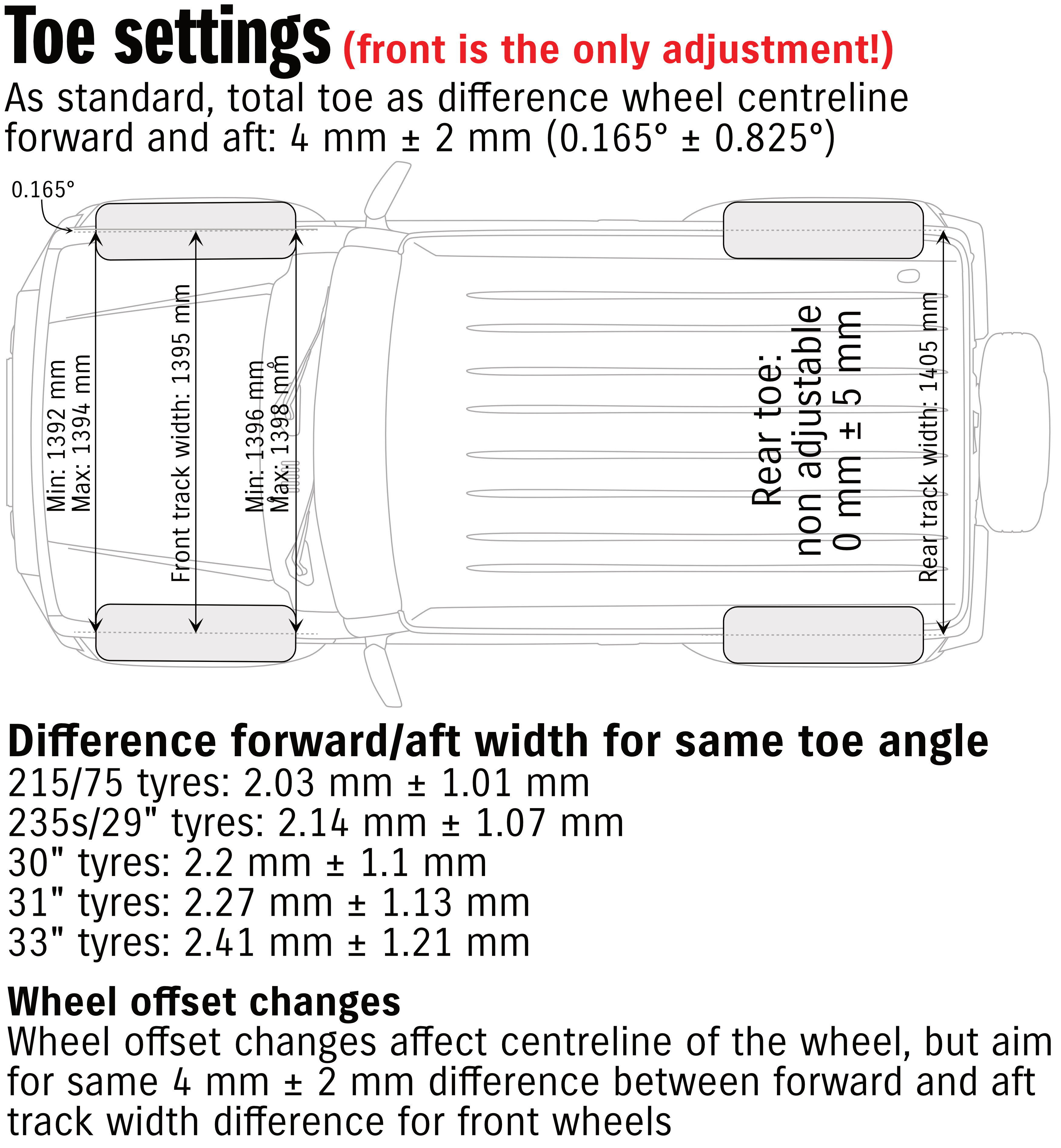
The toe for the Jimny is specified at 4mm +/- 2mm as measured at the centre of the tyres using factory wheels and tyres. Most alignment shops set toe closer to neutral toe for better tyre wear, but bear in mind this does reduce the Jimny’s already compromised straight-line stability.
The key thing here, as I mentioned above, is that toe does not change with a suspension lift. This is a fact often lost on most shops who always specify a wheel alignment should be done after a lift. If the toe was correct before the lift the toe is correct after a suspension lift, since you do not change the distance between the rear of the two wheels.
Another aspect here is that differential toe is not a thing with the Jimny: you cannot set the left and the right toe independently of each other. If your alignment place shows you an alignment sheet with different toe left to right then they did not have the steering box perfectly centred when it was measured.
Resetting the steering angle sensor is a necessary step
Another myth propagated by some people on the internet, and some alignment shops, is that resetting the steering angle sensor is a necessary step of a wheel alignment. It is not necessary for all alignments or after a suspension lift for a few reasons:
- The steering angle sensor is self learning
Why I think alignment shops get it wrong
What should you do after a suspension lift?
To centre the steering after a suspension lift, all that is required is to change the length of the draglink. For a typical lift, only a very small change is required here.
The reason your steering wheel is off to one side after a lift is because the lift has moved the steering box on the chassis away from the passengers side wheel through the magic of just how trigonometry works. By raising the height, say, 50 mm, you slightly change the distance between the two.
Since the physical alignment of the car does not change, what this has the effect of is pulling the steering wheel over to one side.
Why some people – note, note all! – get steering pulling after a lift is caused by this: the car doesn’t know independently what straight-ahead is. With the wheel turned slightly to the side, the steering angle sensor reports some amount of steering.
If this steering angle is less than the tolerance on the steering angle sensor (+/- 10º, now confirmed by scantool data) then the
How to fix it
Check steering centre lock to lock
Check steering centre on the steering box
Physical alignment: toe
Physical alignment: draglink to set physical steering centre
Check physical alignment
If you want to absolutely confirm that the car is not pulling due to a physical alignment issue, you need to disable the electronic power steering. Two warnings about this before we begin, serious enough I will highlight them in red.:
- When you disable the power steering, you have zero assistance including self centering.
The steering will be heavy (goes without saying) but also you’ll learn just how little physical self centering a car like the Jimny has without much caster. - You will need to delete/reset a lot of fault codes in a lot of modules after you do this.
Don’t do this check if you do not have capacity to removed fault codes from modules, and more than just engine codes. szviewer is the ideal tool for this. Some scantools, including good bidirectional scantools, still can’t access some of the Jimny specific modules so it’s worth using something like szviewer independently to clear all errors after you’ve done this check.
The check itself is easy.
- Take out the fuse for the power steering in the fuse panel under the bonnet.
- Now drive the car, noting you’ll have a heap of dash lights and zero power assistance.
- If the car is not pulling (ignore the position of the steering wheel at this point!) then your physical alignment is a-ok, and all you need to do is get the steering wheel centered with respect to the steering box, and the steering box centred with respect to what the car wants for the straight ahead position.
- If the car is pulling then you do need an alignment and to solve why the car is pulling from a physical geometry sense.
Check steering angle sensor setting at neutral steering
Calibrate steering angle sensor and/or ESP sensors at rest
Go for a drive and tweak